In my last post on the textile depression of the early 1990s, I mention “taatit” rugs and a few of you have asked me to expand on them. In 1992 I did some research on taatit rugs and was helped with this by the then curator of Shetland Museum. They also gave permission for us to photograph one of the rugs in their collection and provided me with the following information.
Traditional Taatit Rug, 1993 (image courtesy of Shetland Museum)
“Rug making used to be commonplace in the 1700-1800s. Sadly this tradition died out in the early 1900s. It is difficult to find out when it was introduced into Shetland but it must have been a very ancient origin. The method of rug making was very interesting. The material that formed the foundation, called the “grund” was made of very coarse wool and spun on a special wheel into coarse worsted. It was then woven on a wooden loom into a thick cloth thus forming the base, on which the design was drawn. The pattern was then formed by sewing in the worsted (or taats), these were made from of finer wools and the colours were made from natural dyes, such as lichen, peat and soot, the rest was then filled in with a self colour. When this was complete the “taats” were cut.”
Source: Shetland wool carpeting marketing brochure 1993, information provided by Shetland Museum and Archives
Oliver with Half of a Taatit Rug at Islesburgh Exhibition, 1995
Shetland being the maritime crossroads of the North Atlantic brought multi-national influences to bear on the design and colours. Our elderly next-door neighbour’s father who had been a merchant seaman in the first of the 1900s used to make smaller versions of a similar rug to the taatit rug while on long sea journeys around the world and was no doubt influenced by design and colours from around the globe. I was very privileged to see part of the family collection.
On my journey with the Shetland Wool Carpeting company products, I took with me part of a tattit rug loaned to us. Elderly Shetlanders would comment on the use of taatit rugs in the home, saying they were made for bed covers and some would end up on the floor as decorative mats.
Taatit Rug Alongside Tufted Rugs at Cunningsburgh Show, 1994
The method used by Tammie Irvine to create the Shetland Wool Carpeting Company range of rugs was very different, but a few similarities remained. The raw material used was the same type of Shetland wool, and a wooden frame is also used. The design is drawn on the backing cloth as in the taatit rugs. The rugs were made using an air powered hand tufting gun as shown below.
Tammie Irvine Hand-Tufting a Rug
I truly enjoyed my spell working with our rug project and hearing first-hand accounts of our unique taatit rugs. One lady gave me a copy of a letter written by her grandmother in the very early 1900s to the local chamber of commerce. In it she points out that with the shortage of employment especially involving women, there is an opportunity to set up a rug making operation. Sadly this was not taken up by the authorities; she wished to thank me and our company for finally trying to develop a market for rugs as suggested by her grandmother all those years ago. I gave my copy of the letter to the local museum and archives.
Oliver and Catherine at Islesburgh Exhibition, 1993
In May 1990 I received a shock phone call from Tom Simpson Managing director of T.M.Hunter of Brora (our spinner and major buyer of the wool we purchased locally).
He informed me that they had called in the receivers mainly due to a dire recession in the textile trade and they were sadly left with no alternative it was a sad day for us all but especially the 90 employees at Brora. Eva was off at the lambing and I recall driving out to break the news to her Jim was away lambing in their Island Uyea off the coast of Unst. I was told she was up in the hills I eventually found her and told her the news she remained very cool told me to contact the receivers and ask their intentions.
January 1991 new owners were in place at Brora and the only change was the name now would be Hunters of Brora, we were assured things would return to normal we had a visit from one of the directors almost immediately and to our relief carried on with our business
The recession which affected Hunters was fairly widespread in the textile sector and had an impact on wool trading. The rougher coarser grades of Shetland white and all coloured wools were without a market and were almost worthless.
The reason why there was no demand for the natural coloured wools was the wool mills preferred to dye the white wool into “natural” coloured shade. This was so that they could offer the end user of the yarns a definite constant shade in order to colour match.
Trading standards maintained the word natural could be used to describe the yarn as long as the mills didn’t call it undyed.
It was fairly obvious that something had to change and fairly quickly especially in the case of the native coloured Shetland sheep. In 1991 I was approached by the late Tom Balfour of South Ness Sullom. He said he was an inventor and had designed various machines especially for the offshore oil industry and he knew my boss Jim Smith. He had recently observed an elderly crofter dumping his wool over a cliff and Tom had an idea on how to help find a marketplace he had been given my name by a neighbour and one of J & S wool producers. His idea was to take the lower grades of wool and turn them into Shetland wool carpets, floor rugs, mats, and runners.
This seemed to be worth investigating and with the permission of Jim and Eva I became involved in the project. My role was to provide test samples of the grades and communicate with the spinner in Bradford. After a few months a yarn was produced from the lower grades of wool which the company Shetland Wool Carpeting purchased from J & S, the company was made up of 3 local farmers, a craftsman Tammie Irvine, me and Tom Balfour. The concept was supported by the Shetland Islands Council Development both in advice and financial funding. Rug making used to be commonplace in the 17/1800s; sadly this tradition died out in the early 1900s. It is difficult to find out when it was introduced into Shetland but it must have been a very ancient origin. The material that formed the foundation, called the “ grund “was made of very coarse wool; the “taats” or tufts were made of finer wools. These rugs were initially used as bed covers but many ended up as floor mats, the museum collection of rugs dates back over 100 years with little or no wear. On studying this it became very obvious that our lower grades of Shetland were perfectly suited for a flooring covering strong but soft.
Shetland Wool Carpeting Directors with SIC Officials, 1994
My initial role as well as identifying the type of wool and purchasing it from J & S, was also to assist Tom Balfour in marketing the finished product. In 1992, I attended the British Carpet fair at Birmingham’s N.E.C. a trip never to be forgotten. I said to Tom before the event what was expected of me at this event, “it’s easy” he said “I have been to some of these events you just sit in the corner and grin” exactly what he did while I, along with the manufacturer Johnathon Crossley, spoke to interested parties. The education and experience I gained from this event was invaluable in furthering my career in textiles a week spent with one of the foremost carpet manufacturers in Johnathon Crossley retired former owner and managing director of the world famous Crossley carpets. Talking to carpet makers from around the globe and in particular meeting an employee of a textile company from Switzerland who was over for spell learning from the carpet spinner. He expressed a great desire to see Shetland and see it he did I invited him to stay with Catherine and me at the north road and I am pleased to say we have kept in touch ever since.
NEC Exhibition Centre Birmingham, 1992
After this expedition I was to present a report to the shareholders of the Shetland Wool Carpeting Company and the S.I.C. Development department on the reaction and how the idea was received by the trade and the general public. The result was the company invested further into developing the project and setting up a small scale manufacturing plant in Shetland. After producing some hand tufted rugs and flooring over a two year period I again travelled south with the finished articles to the British Craft Fair in Harrogate, gaining more valuable experience and contacts.
Hand Tufted Rugs with Norse Design at the British Craft Fair, Harrogate 1994
Returning back home we decided to attend local shows with the rugs and I would spend two nights a week attending the Islesburgh Summer Exhibition and over a two year period took orders for quite a few rugs from visitors.
Rugs at Islesburgh Summer Exhibition
Unfortunately for me in 1997 after collapsing with a heart condition I had to bid farewell to the carpets and “Tattit” rugs, leaving it in the capable hands of Tammie Irvine and now sole owner of the company Tammie Irvine.
Tammie Irvine Hand Tufting
Taking stock, we perhaps did not make huge piles of money however speaking for myself this was a great challenge for me and the knowledge and experience I gained from this project has been invaluable.
Also it may have been a coincidence but around about this type the lower grades of wool started to move and there seemed to be an interest in making rugs!
In the mid-90s I was asked by the Shetland Flock Book Society if I could judge the ‘wool on the hoof’; the fleece quality on the live moving animal! This event took place at the annual show and sale of the society held at the local auction marts at Sound in Lerwick, land which is now occupied now by Tesco Supermarket.
The Shetland Flock Book Society was set up in 1927. Its aim to preserve the true Shetland sheep that were under threat from the vast amount of larger breeds brought in by the “lairds”, land owners who cleared the people off the crofts and replaced them with sheep.The group is made up of like-minded individuals who firmly believe in carrying on the work of their predecessors retaining all the characteristic of this special breed of Sheep.
Fine Wool Shetland Flock Book Rams
I was most apprehensive at this task and even more so when I saw the amount of Rams and crofters in attendance. I was standing with my back to the ring talking to an elderly crofter who was one of Shetland’s most revered stock men when my name was shouted out. Turning around I was met with a packed sale ring full of rams and a circle of faces their eyes fixed on the ring. “Help” I whispered to the old gentleman who said, “Look at that ram, you will not get better. His wool is perfect, the wool staple has got the ‘bird’s beak’ effect and it is open and soft”. He continued quietly, “Gradually reduce the number of sheep in the ring and end up with six and make a big fuss, take your time and make sure that one is the winner!”
I followed his instructions and looking up, the sea of faces appeared to have lost their smiles all except my helper; the owner of the winner announced “You certainly know your stuff!”
Me Judging Shetland Flock Book, Old Marts 1995
At the time I was not aware of the relevance of this invitation and how it would have such a positive impact on all things connected to Shetland wool in years to come. I will deal with this in more detail in a future blog post.
Me Judging Shetland Flock Book, 2015
The popularity of Shetland Wool Week since 2010 and its global appeal has highlighted the Shetland breed of sheep as one of the finest wool sheep in the world. In 2011 the Shetland Flock book society received another marketing boost in the form of Vispring, one of the world’s leading bed makers, who use Shetland wool in their range of beds. Vi spring is the main sponsors of the Shetland Flock book show and sale. Not only on the hoof but also sponsor the Flock- book fleece competition.
Vi Spring Wool on the Hoof Award to the Doull Family
Following is the 1927 standard for pure bred Native Shetland sheep:
Shetland Sheep Scoring
Description and Scale of Points Score – 100 Points
GENERAL CHARACTER AND APPEARANCE
Horned or Hornless
9
HEAD – Good width between ears, tapering rapidly to base of nose, which should be broad and with little tapper to muzzle, hallow between cheeks and nose well marked
9
FACE – Medium length of face from eyes to muzzle, nose prominent butnot Roman, small mouth
9
EYES – Full, bright and active look
3
EARS – Fine, medium size, well set back, carried slightly above horizontal
4
NECK – Full, tapers into a fairly broad chest
4
SHOULDERS – Well set, top level with back
6
CHEST – Medium width and deep
5
BACK – Level, with as much width as possible
9
RIBS – Well sprung and well ribbed up
4
TAIL – Fluke tail. Wool at root forming the broad rounded part, and tapering suddenly to a barely covered fine point. This is a strong character and any crossing is easily made out by it. Length varies according to size of sheep, rarely exceeds six inches, or thereby
9
LEGS OF MUTTON – Light, but very fine in quality
4
SKIN – Varies according to colour of wool. In white no blue or black colouring
4
WOOL – Extra fine and soft texture, longish, wavy and well closed. Wool on forehead and poll poll tapering into neck, likewise wool on checks. Colours: White, Black or Brown, Moorit (from reddish to fawn), Greys (including Sheila). Other known colours: Mirkface (brownish spots on face), Catmogit (black underparts from muzzle to tail and legs), Burrit (light underparts); also Blaegit, Fleckit and Sholmit
20
CARRIAGE – Alert and nimble, with a smart active gait
2
TOTAL = 100
DISQUALIFICATIONS:
a) Long heavy tail, broad to point. b) Bad wool, coarse and open. c) Very coarse wool on breeches. d) Deformities of jaws. e) Undersized animals f) Defective coloured or badly shaped animals as sires. g) White hairs in Moorit and Black, and dark hairs in White wool. Please note the importance of wool by it having the highest points awarded to the characteristics of the sheep.
My first experience with judging Shetland wool was in the late 1960s, at J&S wool store, and it was an open fleece competition organised by the local shows. The judge was a prominent wool merchant, the late Mark Stewart. His company was Stewart Brothers, Constitution Street, Leith, Scotland, bought wool from J&S. The Stewart family originated from Levenwick in Shetland and the company was founded in 1878 by a William Stewart. They also had weaving sheds in Shetland and employed many Shetland crofters. The Stewart family moved down to the mainland in the first of the 1900s and carried on their business as wool merchants and weavers.
I had to unroll the fleece for Mark on the sorting table; I recollect there were quite a few entries, crossbred wool as well as Shetland. Mark Stewart used judging sheets which were on a points system covering eight wool points – Trueness to wool type, Conformity of length of wool staple, Soundness (strength), Handle (softness), Colour, Character (crimp), Fibre Fineness, and Presentation.
At the end of judging it appeared to me on the points allocated it was a tie for first place. A very fine Shetland and a fleece from a Pettadale sheep, a cross bred, 75% Shetland and 25% Romney Marsh. This breeding programme started in 1959 in Weisdale Shetland, the idea being was to combine the fine fleece quality of the Shetland with the body weight of the Romney to produce lambs that are heavier than Shetland lambs and a heavier fine fleece.
There was no joint first place! I was to find out that the total points scored was multiplied by the fleece weight and the much heavier cross bred was declared the winner. This was met with some dissent by purebred Shetland sheep breeders, in later years there were two separate classes of fleece, much fairer.
My first hands on experience of judging took place in the 1970s, when I took over from my boss as a wool judge. This meant travelling to local agricultural shows held in Walls on the west side of Shetland and Cunningsburgh to the south.
Judging Fleece Competition
I had the honour of judging with local characters such as the late Benjie Hunter a renowned sheep and wool man who instructed me into the finer points of classing wool. Benjie would spend a lot of time inspecting the wool in particular looking for “kemp”, a coarse white fibre. He maintained if you were to find kemp hair this meant that there were a cross bred influence somewhere in the animal’s pedigree.
Benjie Hunter, Wool Judge
My most vivid memory of judging wool was at the Walls show in the early 70s with an elderly lady who came from a family of wool merchants. She had been a wool buyer for her family business. Half way through the judging she announced to the steward “we need a break”, where on we went out to her van and she produced a bottle of whisky complete with tumblers. I thought this was a bit odd but as the “junior” I should say nothing. She recounted tales of wool purchasing travels from the past and of her family’s business. I was totally carried away by her accounts and drams and was brought back to reality by the wool steward banging on the van roof, special memories.
Finished Judging Coloured Fleece
In the late 1980s/early 90s, I along with two other judges, judged the Shetland Fine Wool project, the aim to produce a larger fine wool sheep crossed with the L’Est A Laine Merino ram to the Shetland ewe, which was called the Lomand. The end result was a sheep with a more marketable sized lamb, whilst retaining the fine wool quality in larger volume per animal. Although it produced a very fine fleece and, on average a much heavier fleece the finished carcass did not suit the market place and the project in Shetland ended in the early 1990s.
Shetland Fine Wool Fleece Competition JudgingVery Fine Wool – The Lomand SheepFleece Judging Sheet
As years passed working with Shetland wool I naturally gained hands on experience as well as instruction from more experienced individuals be it crofters, farmers, or wool merchants.
In my previous blog on Shetland sheep I mention the Shirreff report on Shetland sheep and wool. We appreciate nothing much has changed up to the present day in that there are still two distinct types of Shetland sheep. “A ‘kindly’ fine wool sheep, the other of mixed quality with wool that is partially coarse”. It is very obvious that these two distinct types of Shetland sheep interbreed and so you have a mixture of wool qualities.
The fine fleece has an even and well defined crimp, with an even and uniform length of staple, it should also have sufficient tensile strength of staple, and the fleece should have a soft handle. Over the years I have heard two explanations of the required length of “Britch” on a fine Shetland fleece. The Britch should be covered in the palm of your hand with no coarser wool staple visible. The other theory is that the Shetland sheep needs a heavier “Britch” or hips to protect it whilst resting on the heather.
Fine Wool Ewe
The finest Shetland wool cannot match the micron count of the Australasian breeds, such as the Merino, on fleece average the finest Shetland comes in around 24.5 microns while the Merino can be in the teens. The Shetland fleece soft springy handle is much more superior to that of the Merino which has a dense feel to it.
The other coarser type fleece has a much longer staple, with little in the way of crimp and consists of two parts, “and not two separate coats”, a stronger coarser fibre in order to protect from the inclement weather and the under part of the staple for warmth. Some older crofters would tell me that in a really hard frosty winter the sheep would produce less outer wool but more inner wool for warmth.
Coarse Wool Grey Ewe
In 1978 came the introduction of the wool grading scheme, a much fairer system to all concerned, producer, merchant and end user. Five grades of white wool, and two grades of coloured, was introduced which applied a standardised grading system that the purchaser of the wool could work his margins from. We still stick quite rigidly to this method of grading today. As the main buyer of the local wool clip, over 80%, according to local trading standards, we have a responsibility in our handling of the clip for all parties involved in the wool process. The only down side in my opinion in the system is that with two separate companies in the islands grading the wool if there is not combined continuity of standardised grading there is an in-balance of end results, which causes confusion.
Grading Shetland Fleece
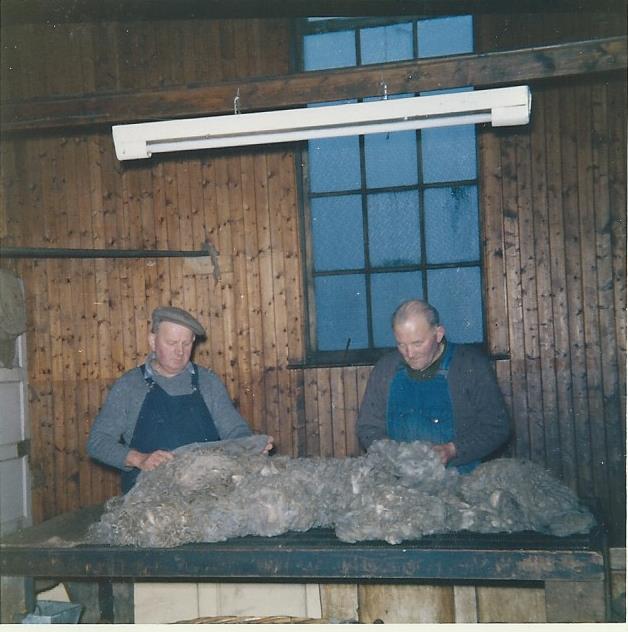
The grading is determined by the wool quality, if there are more coarser fibres present the lower the grade. Presentation of the fleece that is rolling it from the Britch to the neck with the wool staple outward is how it should be done. In most Shetland fleece the finer wools are more prevalent around the neck and shoulder areas. A perfect example of fleece presentation I was personally involved with took place in the first and second year of the scheme. A crofter approached me at the end of the first grading year and stated he was disappointed with his wool returns having only a small amount of grade one. I took a Shetland fleece on my sorting table and proceeded to roll the fleece from the Britch to the neck folding in the coarser staple out of site, explained he had not rolled his clip and so had not shown of the best of his wool. The end of the next wool season my boss asked me to explain why the same crofter’s wool clip was mostly grade one!
Fine Shetland Fleece
Because of this mixture of wool qualities occuring in a fleece it is very necessary that after grading wool sorting has to be done and the only means to separate the different types is by hand. There are various types of qualities sorted depending on the finished product. The stronger guard hair wool staple (lock) which can form part of the fleece, is sorted away leaving the finer fibre which will be used in high quality knitting yarns such as Shetland Supreme lace. This is a very time consuming and skilled job which is very necessary in order to produce a high end quality product. Sorting is done after the wool is graded and done in the quieter winter months, very similar to the method introduced by “Sheepie” s explained in my previous blog.
Grading in 1965
The lower grades of wool and the coloured wools were very difficult to find a home for up until the mid-1990s, I will explain the change in later blogs.
Coarse “Scadder” Fleece
Definition of Terms Used in Grading Specifications
Degree of fineness The diameter of the wool fibre influences to a large extent the use to which the wool can be put and also the length of yarn that can be spun from a given weight of wool. Users and manufacturers normally use a series of quality numbers to indicate fibre diameter. These numbers, in ascending order of fineness are, are 28s ( the thickest, coarser fibres ), 32s, 36s, 40s, 44s, 46s, 48s, 50s, 56s, 58s, 60s, 64s, 66s, 70s, 90s, 100s (the very thinnest, finest fibres). Most British wools are within the range 28s to 58s. Shetland finest 58s – 60s. Quality numbers are not based on any particular unit of measurement; they are standards handed down from generation to generation of wool men and can be learned only by practical experience and handling of wools.
Length of Staple This is the measurement of the unstretched staple from tip to base. The figures quoted are standard for each grade.
Handle of Wool The softness or harshness of the wool when handled.
Degree of Lustre This refers to the amount of gloss or sheen visible on the fibres. Degree of lustre varies greatly between types. A bright lustre is an asset for certain manufacturing processes.
Colour The nearness of the wool to white ( or black in the case of black fleeces).
Strength The ability of the staple to resist breakage during manufacture. The word “sound” is used to describe wool of satisfactory strength rather than “strong” which, in wool terminology, refers to thick or coarse fibres. The opposite of sound wool is “tender” wool. Tender wools may have a break in all the fibres at one point in the staple as a result of illness or drought or in the case of the Shetland a very hard frosty spring.
Other Terms Used Include The presence of grey or black fibres in a fleece restricts its dyeing range to the darker shades. This fault occurs in many of the white – woolled breeds.
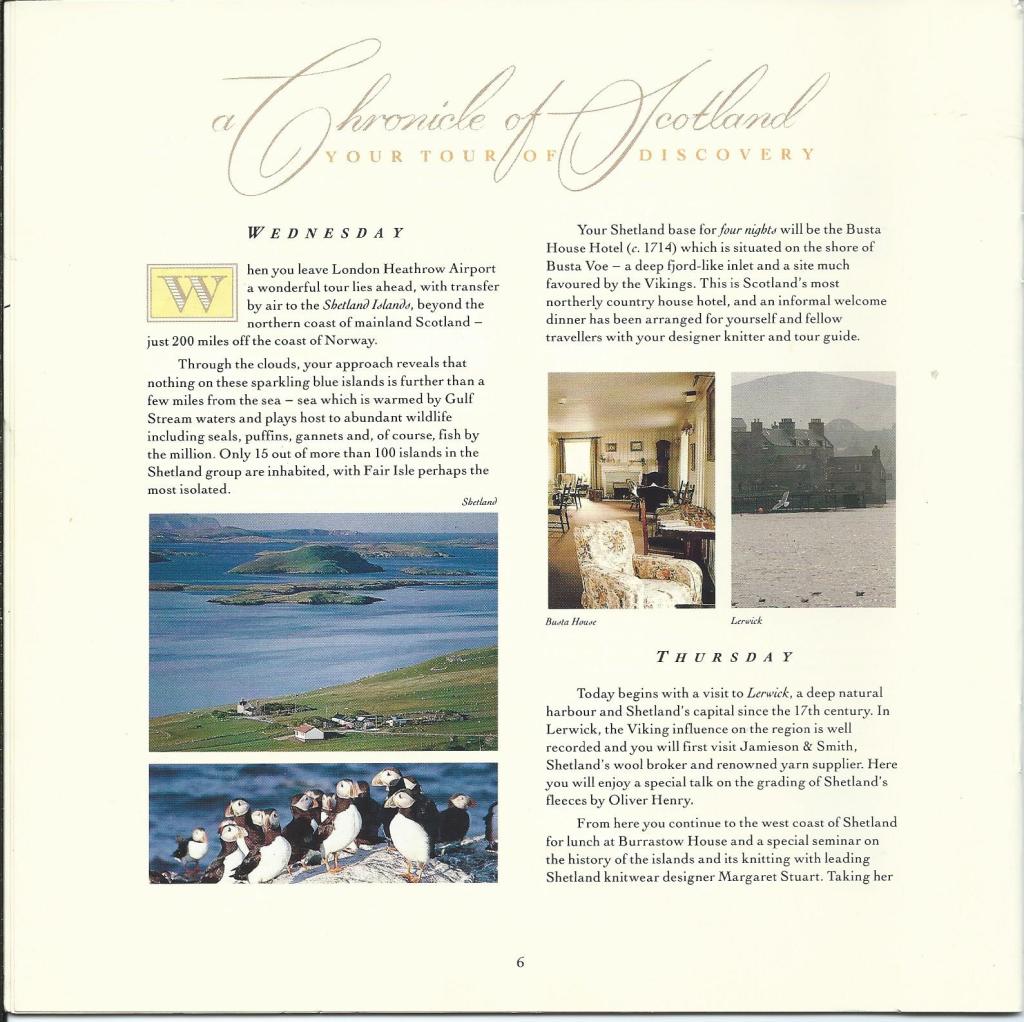
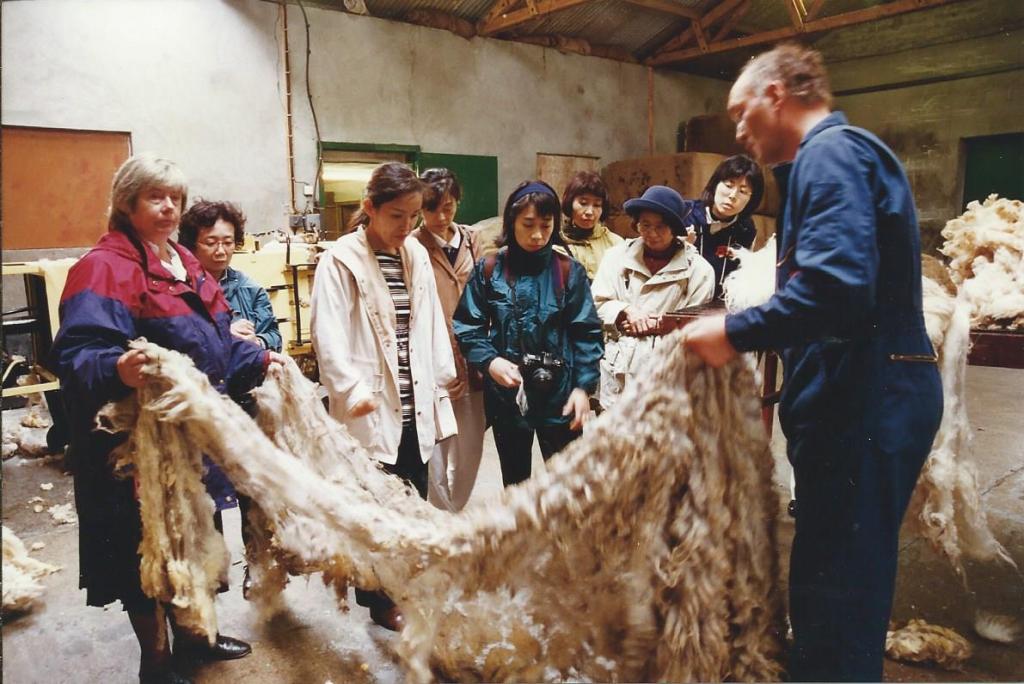
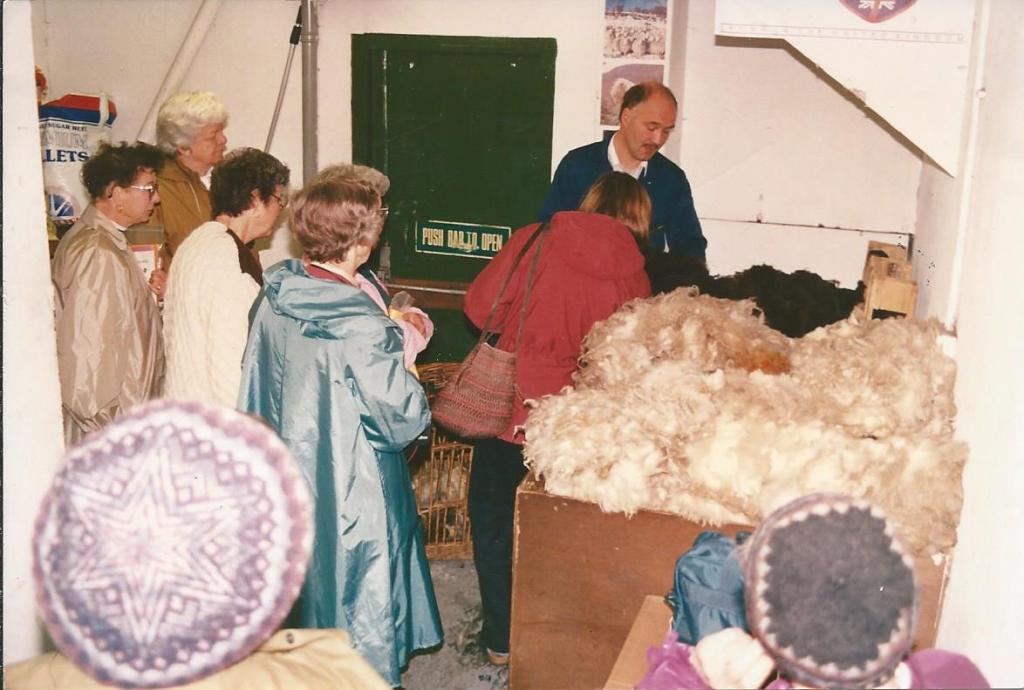
In the late 1980s I became involved with visiting groups such as the Rowan Travel Heritage Tours the Wool and Wonders of Scotland. My role was to give a talk on all things wool related, sheep, yarns and textiles in general. Rowan’s groups hailed from all parts of the world and involved visiting all the scenic parts of Scotland including Shetland, and the Western Isles, seeing hand knitting and weaving and meeting the artisans of the various crafts.
Rowan Tour – Shetland Visit
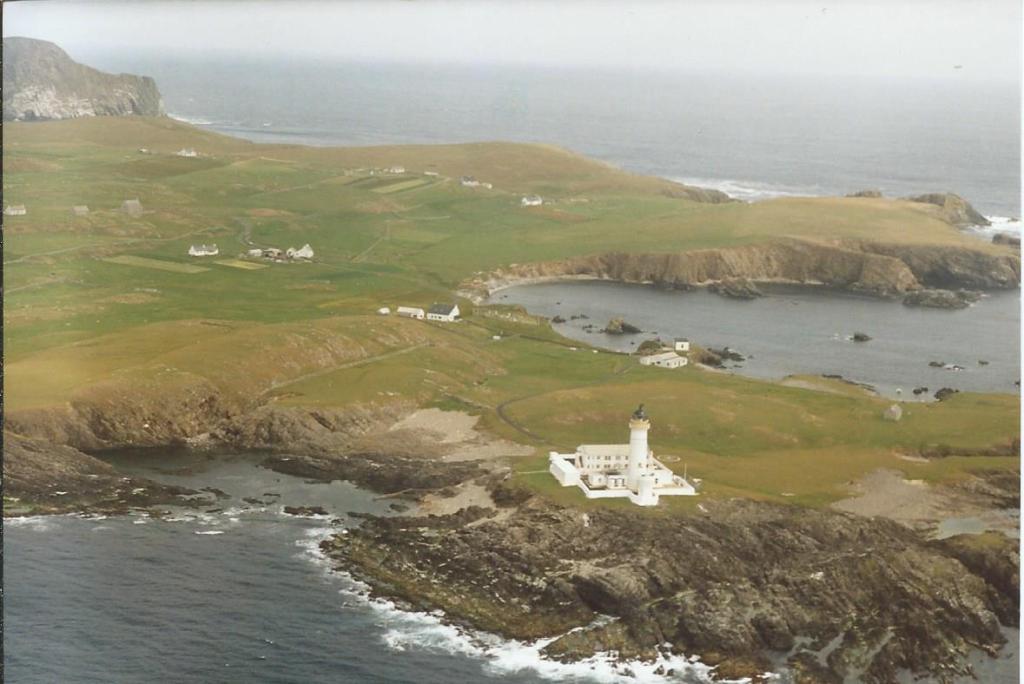
The Shetland trip included a day trip into Fair Isle a journey by helicopter from nearby Sumburgh. My wife Catherine and I were guests of this particular group and accompanied the group into Fair Isle a very memorable visit indeed.
These tours were a very important means of marketing. It was meeting with the end user and what better way to pass on your company’s activities and products than by word of mouth.
Fair Isle Lighthouse from Helicopter, 1992
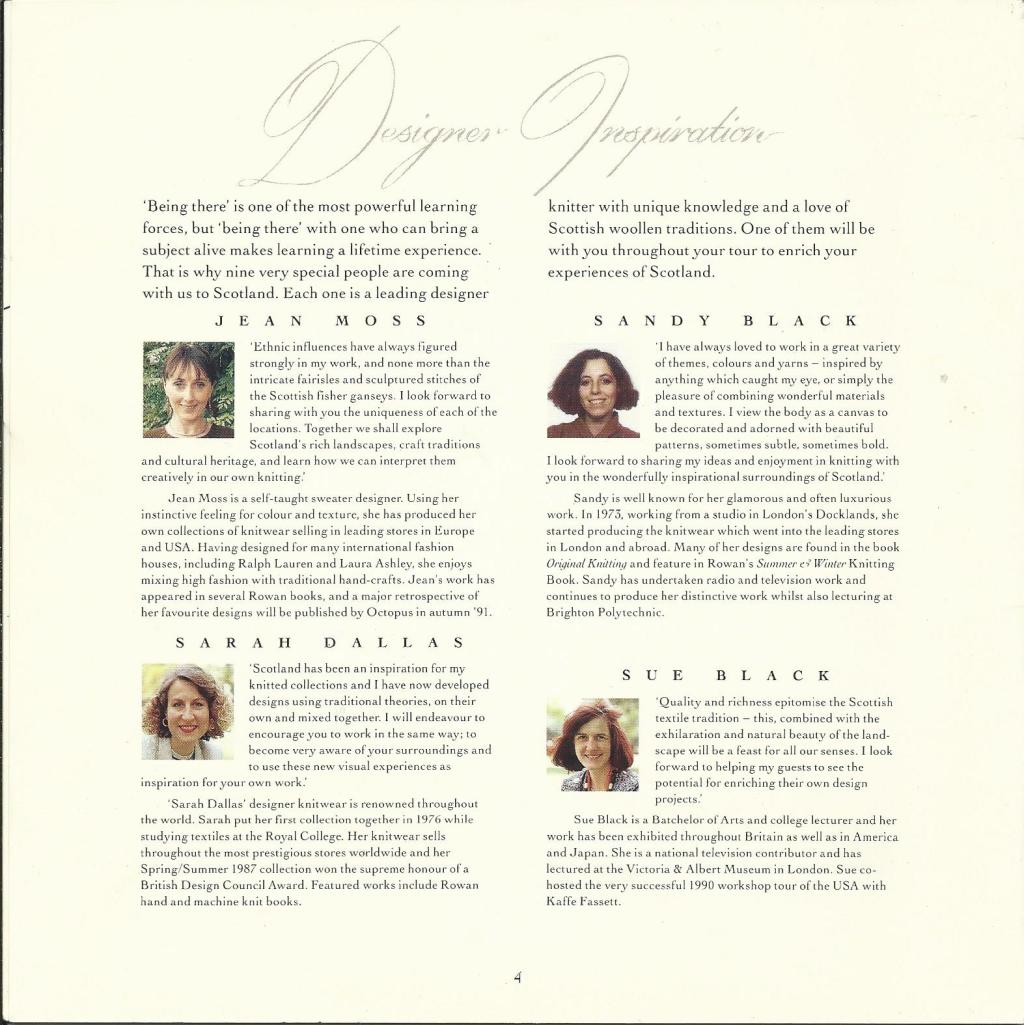
Travelling with the group would be their very own designer, being there is one of the most powerful learning forces but being there with one who can bring a subject alive makes learning a lifetime experience. Leading designers included well- known names such as Jean Moss, Sue Black, John Allen, Alice Starmore, and Kaffe Fassett (to name but a few). I had a request from Kaffe Fassett who wished me to come in on my day off, Sunday he needed to prepare for his class. This was an extremely valuable opportunity learning a little about the skills of colour blending instructed by a master in the field.
Designers of Rowan Tours
Another visit stands out in my mind of a huge group of Americans on a Sunday morning. The previous night I had attended the Yell Agricultural Show presentation only arriving home by ferry at 7am after a long night of revelry and drams. Facing a sea of faces at my sorting table I simply froze and lost my words; a very strange occurrence indeed! I excused myself saying I need a drink of water and I apologise for my poor performance I come from a small Island off the west coast of Shetland and I am only half civilised. One elderly lady replied “Honey I come from the middle of New York, and I aren’t civilised at all!” This was met with rapturous applause and I was most grateful to the lady; her profession, a lawyer.
Textile Tour Visit in 80s
Gladys Amedro and her husband played an important part in these tours; Gladys would give a talk and demonstration on her lace knitting and design. Her husband Buff would accompany me in the wool store and listen in, after my very first presentation his advice was tell the story of the crofter fisherman the culture & heritage. Wise words; tell it as it is.
I suppose my first memory of Shetland sheep was our pet ewe Blackie when I was a child. However my own serious interest in Shetland sheep began on my visits to the crofting district of Vidlin and the Robertson and Johnson families of Kirkabister. It was here I learned all the basics of sheep husbandry which was to hold me in good stead later on in my working life at Berry Farm and J&S.
My daily contact with crofters in my work place was a great source of information especially when I was asked by the Shetland Flock Book Society to judge the live animal for wool quality at their annual show and sale. I sought advice from two of Shetland’s highly respected sheep breeders who instructed me on what to look for.
Shetland Ewes with Lambs
The Shetland is the smallest of the British breeds, found mostly in the Shetland Islands. It is believed to be of Scandinavian origin, most probably brought to these shores by the Vikings, who settled over 1000 years ago. The sheep may have bred with primitive sheep already in the Islands. This cannot be proven, but they retain many characteristics of the wild sheep. They are small bodied animals with a distinctive face and nose, bright eyes, small erect ears and usually wool on the forehead. The legs are fine and of medium length. A distinguishing feature is the tail being fluke shaped, broad at the base and tapering to the point. Rams have nice round horns while ewes are mostly hornless.
Shetland Ram with Round Horns
Their wool is most distinctive, being of very fine fibre quality, with a very soft silky handle. Being a small animal the fleece weight is only 1 – 2 kilos on typical hill ground, but can increase in weight on a richer greener pasture. Staple length is approximately 10 cm, usually with a wavy crimp.
The fleece colour is mainly white, but one can get various other shades. For example “moorit”, (reddish brown) “shaela” steel grey, and black (dark brown). You can have variations of these shades but they are less common. Shetland sheep are primarily known for their wool, but they also have some other notable features, being very hardy and agile, and able to withstand harsh weather conditions. They can pick their way down dangerous cliff ledges to get to the sea shore, where they supplement their feeding by eating seaweed in the ebb tide. Their size enables them to find shelter in exposed places. They also make ideal mothers, and are much sought after to cross with the Cheviot for their mothering abilities. They are both prolific and long lived. In fact there is an instance at Berry Farm of a ewe that had twins at the ripe old age of 21 years and lived a further 6 years.
Shetland “Moorit” Ewe
Another great source of information to me was crofters talking of a historic report on Shetland sheep; I found one in particular to be of a great help. I was attending a talk on the origins of Shetland sheep by Dr Carol Christensen from the Lerwick museum. I was asked a question from the audience on wool quality and made mention of the information on that type of wool given to me by crofters who had knowledge of a detailed report on Shetland sheep in the early 1800s.
Imagine my surprise at the end of the talk when I was handed a photocopy of the report in question by the museum curator, featuring the Shetland sheep and wool section. It was carried out by the board of agriculture based in Edinburgh and published in 1814. The objective of the report appeared to be means of improving agriculture in our Islands and carried out by the reporter John Shirreff.
An extract from the report; “The Shetland sheep is the ovis cauda brevi, common to Norway, Sweden and Russia, this breed or variety resembles the argali, or wild sheep of Siberia, more than any other breed does.” Perhaps these sheep were brought over to Shetland by the Vikings when they settled here?
Horned Shetland Ewe with Rough Wool
The reporter, Shirreff, appears to agree with a Mr Culley a previous writer on the subject that there are two distinct breeds of Shetland, the “kindly” fine wool sheep and another of mixed wool quality the fleece although some of it is fine, it is a quality unfit for any general purpose of manufacture.
The “kindly” (fine) wool sheep was of course most valued for its use in high quality knitwear production in the wool industry at that time and fine wool sheep were carefully protected. It was for these economic reasons that Shetland sheep breeders took careful steps to preserve this valued commodity vital to their survival.
Shetland Ewes and Lamb with Fine Wool
My close friend the late “Jeemie” Moncrieff, general manager of Shetland Amenity Trust, presented me with a copy of one of the first recorded testimonies to the skill of the Shetland crofter’s animal husbandry this dates back to 1298 and the” rettarboetr” of the noble lord King Hakon. “Hakon by the grace of God, Duke of Norway, son of King Magnus the crowned, sends God’s greetings and his own to all men in the Faroes who see or hear this document. Our spiritual father and dearest friend, Erlendr, bishop of the Faroes, and Siguror law-man from Shetland, whom we have sent to you have pointed out to us on behalf of the inhabitants of the islands those things which seemed to be deficient in agricultural law. We therefore caused to be drawn up on these four pages the ordinance we have made up in accordance we have made in council with the best men, in accordance with what we trust will be of greatest benefit to the people”. I shall not recite the whole four pages setting out their laws only the start of the section on sheep. “We have heard about the bad custom concerning sheep which has been more prevalent in the country then it ought, and which does not befit us to allow to continue, so that everyone has what is his.”
So even in these early years the skilled practices carried out by Shetland sheep breeders were being recognised and passed on to other neighbouring Island groups in order to help them with their economy which naturally would benefit their lords and masters based in Norway. In present days the Norwegians prove to be a very industrious organised nation and it is little wonder they are the richest country in the world.
This sheep breeding skill carried on into the 20th Century, 1927 to be precise when the Shetland Flock Book Society was set up to preserve the fine wool Shetland sheep and to this day their recommendations are strictly followed. With the clearances of crofters from the native hills and moors by the lairds and replacing the people with the introduction of breeds such as Northumberland mugs and the Black- faced, with probably, a dash of the Cheviot breed, all crossing or “tupping” the native Shetland ewe it became fairly apparent something had to be done and fairly soon or else the original native Shetland would disappear.
Fine Wool Shetland Rams
The Shetland Flock Book Society formed in 1927 to safeguard the true Shetland sheep still is going strong today. I will talk about this and Shetland wool in more detail in later blogs.
Perhaps it was because of my new role within the company that I became more aware of situations beyond our control regarding less favourable aspects of business life. Unfortunately this is a part of my life and experience with wool which has continued to escalate.
Most of the Shetland yarns you are offered today will contain no Shetland wool from the Shetland breed of sheep. I have spent over 50 years of my life handling Shetland as well as pure Shetland yarns produced from the wool that has gone through my hands. According to our local trading standards, over 80% of the Shetland wool clip comes through the wool brokers so it would be fair to say I know where that wool ends up. In the early 1980s there was a marked increase in so called Shetland yarns and products made from foreign wools.
Fine Shetland WoolFine Wool Rams
This situation is similar to Cheddar cheese and was summed up extremely well by my old friend Alistair McDonald who had spent many years in the Scottish textile industry, formerly of Hunters Wool Mill; I quote from his textile dictionary:
‘Cheddar cheese and Shetland now describe types of products which may be far removed in quality and substance from the original. The Cheddar and Shetland stories are both illustrations of the popularity and demand for a product outstripping any possible supply. In these conditions a different product with some similarities to the original is put on the market and the name is hijacked. Even if at first the new product is not accepted by existing customers eventually the entrepreneurs will assiduously work away at promoting it and eventually the new items will be accepted as the real article. The ultimate customer, perhaps never has known the original, can make no comparison and accepts the new product with the false name. In time the quality of the original can be forgotten. Just as cheddar is now ubiquitous to the supermarket so now Shetland is ubiquitous in the textile market place.’
Alistair, in his report, says he was on an Island in the Indian Ocean, Mauritius, hoping to interest the local knitwear producers in the Shetland yarn from Scotland which he was trying to sell. This yarn had the advantage of containing wool from the Shetland Islands.
Mauritius was at one time the largest producer of Shetland garments in the world supplying most of the U.K. chain stores. The main reason why he had no success was that they, the local manufacturers, were buying a New Zealand Shetland Type at half the price he was quoting. There was also a spinning mill on the Island making their own Shetland wool.
As if to confirm Alistair’s discovery, a few years after his visit I was approached by a local Shetland Islands councillor with a swing tag reading 100% Shetland wool garment purchased in Mauritius by a local lady on holiday there at the time. I told him to contact our local trading standards. The next week the Glasgow Herald contacted me about similar sweaters they purchased with similar descriptions, I said this was a disgrace and the situation was affecting the returns of the genuine Shetland wool producers. I told him to contact our Island’s council trading standards.
If this was not bad enough the company I work for, Jamieson & Smith had its name hijacked and a website appeared named Jamieson & Smith (substitutes). When the unsuspecting customer logged in to the web site they were redirected to another company’s yarns. According to an intellectual lawyer I consulted, this was highly unethical and could be legally challenged in this country with a successful outcome for us. As the perpetrator was based in Canada it would be an expensive and exhaustive process for us to gain a prosecution, which the people responsible knew only too well.
Back in the late 1990s, I was approached by two media sources; could I explain why I had a company called O. Henry co.ltd based in Japan, and which did not exist in any-countries companies’ house records or trade directory? At the time I was involved in working with a Shetland Islands Council department with the Shetland Wool Carpeting company project. I had to make the officials aware of this, I was told an independent investigation in to this company address in Japan had traced it to a run- down warehouse above a rice shop, the occupant of the rice shop said he never saw his upstairs neighbours! Intrigue indeed and best left alone, one can only summarise as to the activities.
This hijacking of a company’s name and product is most likely common place in business and was best described by my late boss Jim Smith, “they are piggy backing our ideas,” similar to his turnip invention perhaps!
It would be fair to say that this type of “Shetland” and dubious business practises has a detrimental effect on genuine Shetland wool producers and textile workers that use the real Shetland wool product. This is something I have always tried my best to combat, to protect all those who rely on the production and sale of their genuine Shetland wool – the crofters I have worked with all my working life.
Crofters Waiting for the Boat (courtesy of Kathleen Anderson)Croft at Clavil, Bigton
What can be done – the end user of the Shetland product should be sure that it is from a genuine source and the product has genuine Shetland characteristics in the case of wool a soft handle.
As I said in a previous blog, unlike Harris Tweed and their Orb trade mark Shetland has no such protection. In the early 1990s I along with the local National Farmers Union president tried to make the point to the powers to be – sadly with no success.
There was a glimmer of hope in 2003 with the publication of a report commissioned by the two local authorities; Project Seilkie in which I took part. The aim was to brand Shetland and all its unique products, sadly this never happened which was a great shame as the report highlighted the need to protect our Real Shetland brand, be it food or wool.
At J & S we along with the parent company Curtis Wool Direct registered the Three Rams trade mark which guarantees the wool and its product came from the Shetland Islands. We also try to combat this false “Shetland” by telling our own unique story of our products made from one of the finest wools in the world.
Three Ram Logo
Despite not being the most light-hearted of subjects; I feel very strongly about the preservation of true, genuine Shetland wool; not as a product to be sold, but as a vessel for our local heritage, culture and spirit of the Shetland Islands. It is vital that we support our local crofters and businesses as a way to preserve a way of life which is slowly being overtaken in such a fast-paced world where little heed is paid to authenticity. I hope that in my time with J & S I have done some good in helping to call attention to this as an issue – however, not wanting to step on any toes!- it is up to those who are purchasing wools, yarns and garments to be aware of the source.
Although the company was doing well with increased yarn sales the wool trade it was very depressed. The lower grades of wool including the natural coloured fleece were not in demand, the rougher Shetland which featured the outer guard hair was unsuitable for knitting yarns. The native Shetland natural coloured wool again had no market value. Wool mills preferred to dye up the white fleece and make it look natural, the reason given was so they had a constant shade to supply the end user and guarantee uniformity of shade.
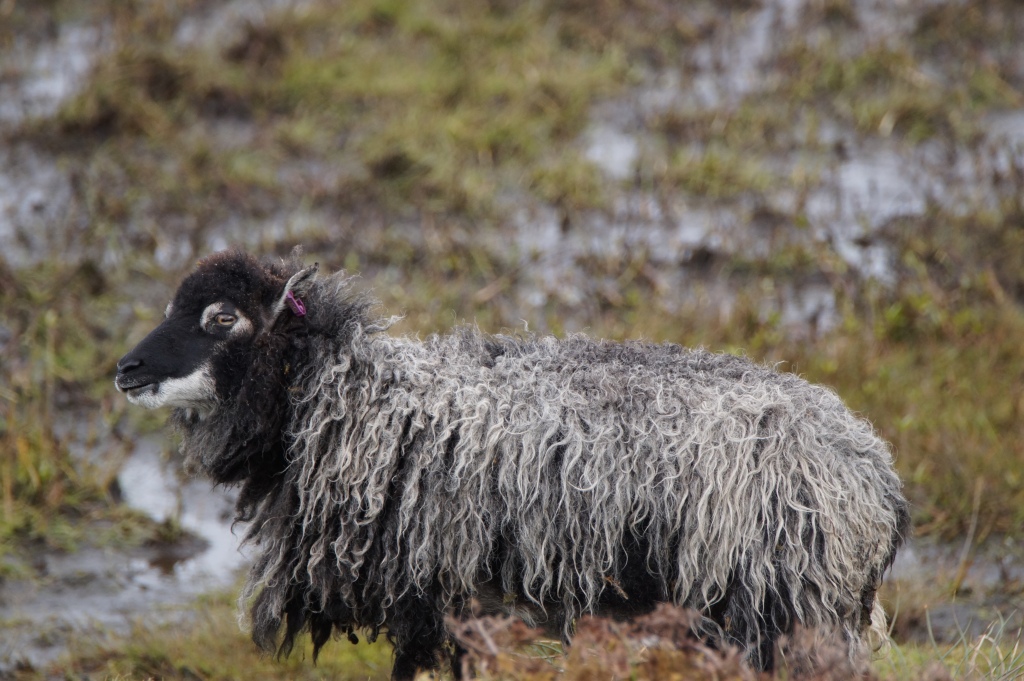
Native Shetland Coloured Sheep
We did see an increase in the so called Shetland yarns made from foreign wool and passed off as the real thing. The genuine Shetland brand name was being hijacked and unlike Harris Tweed and the Orb trade mark, Shetland had no protection to halt this. The local farmers union and crofters unions tried unsuccessfully to fight this but to no avail. This was having a severe negative impact on local wool prices.
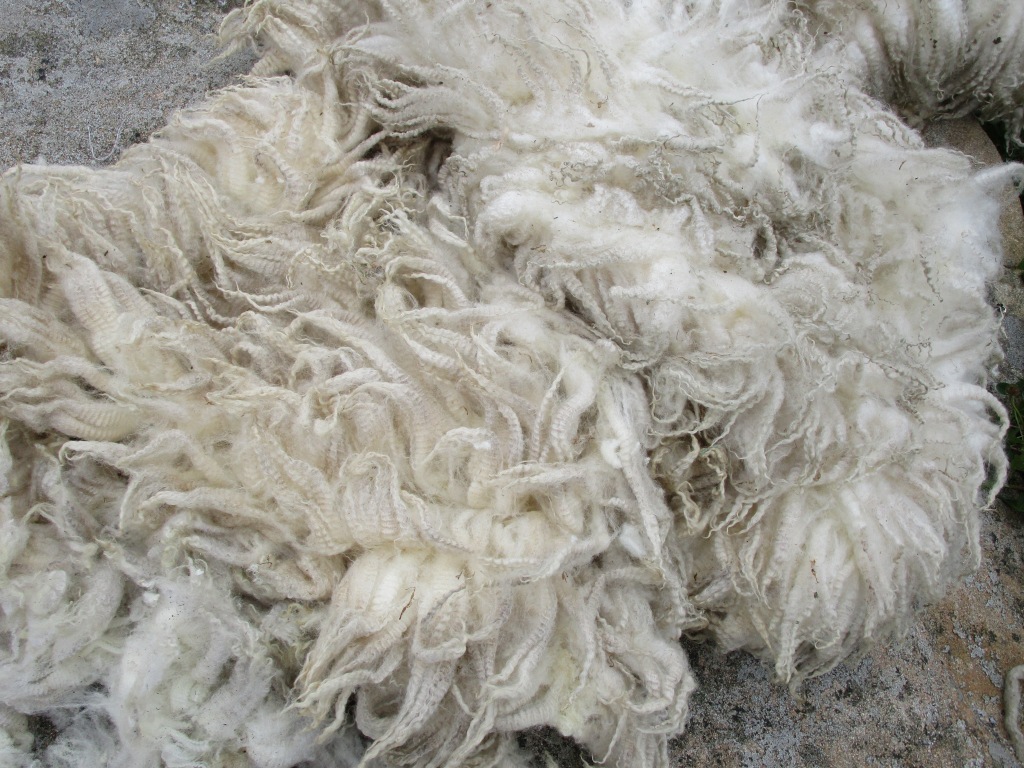
Fine Shetland Fleece
In the early eighties due to ill health Mr Johnstone retired at the age of 73 and sadly passed away in 1986. I had worked with him for nineteen years he was a hard task master, a business man fully committed to the company and extremely loyal to his work force. He was a very private man not exactly a people person. For instance he would reprimand me for talking to visitors saying “do not depart of your knowledge”.
It was while attending his funeral in his home island of Yell that I learned of his past life. At the age of 14 on the death of his father he took on the family business part of its activities being hosiery, in Sellafirth in the north of Yell and did so until the mid-1950s before moving to Lerwick. He also was a decorated chief petty officer in the Royal Navy in the Second World War which explained to me his ruthless efficiency.
As I said earlier when asking Mr Johnstone for more time off at nights for football he gave me a choice, your job or football. So it was a great surprise to me that when visiting his family after the funeral his sisters told of how they had to go with him to Seafield to watch me play my first official game for Shetland against the Faroe Islands, 5 goals to 1 in favour of Shetland. They said he hid behind a parked van, watched the game and told them I was not to know he was there!
I learned a lot from him not only wool and yarn but of life in general and at times you had to become very firm and stand up for what you believed in and never forget your morals and your scruples.
Shetland Football Team, 1974
In 1983 we had a visit in the wool store from two high ranking Shetland Islands council officials who were being shown around by J & S owners Jim and Eva Smith. I started to take an interest in the conversation when I heard the older official say “we will spin all the Shetland wool in the islands and pay a premium price to local wool producers”. Eva asked, “What happens to our company?” “Firms come and firms go” was the reply. Eva asked “what happens to our staff”. Pointing at me the official asked what does he do “He, Oliver, is our grader/sorter” she replied. “He will get a job in our wool mill out in Sandness,” was the answer!
I made one mistake that day, I told my wife Catherine, who was born in the village of Walls; close to the mill and said. “It looks as if you will get your wish and we will be living in your birth place Walls”.
Sadly this was not to be and over a period of time she stopped asking when we would be moving. We still are living next door to the wool store and still handling the bulk of the island’s wool clip.
One could not have blamed the Smith family if they had decided to cut their losses and wind up the business, losing their driving force Mr Johnstone. Perhaps they were taking the council official at his word and the inevitable would happen and this would be a way out for them?
Jim and Eva advised us they would carry on with the business and Eva would take charge I would be manager of the wool-store, as well as some of Mr Johnstone’s work.
I now needed help to fully understand all aspects of the business. It was at this time that I took up the offer from Tom Simpson, general manager of Hunters of Brora, “you must come and see the magic “and visit the wool mill”. My wife Catherine and I travelled down and had a very memorable visit indeed. Hunters were the major employer in the village and surrounding district and were prominent globally. Hunters Tweed cloth was supplied to most of Scotland’s country estates; the perfect hard wearing apparel for outdoor life, game keepers, gillies and estate workers.
Front Gate at Hunters of Brora
I now had to learn more about textiles as well as the basic raw greasy fleece. Mr Johnstone had been the point of contact between J & S and Hunters and this role now became my responsibility.
Hunters’ Bill Ballantyne, spinning mill manger, and his staff helped me understand all that was necessary in producing Real Shetland yarns. However the person who gave me the most help and information was Alistair McDonald a yarn salesman for Hunters, Alistair had previously been in charge of his family textile business in the Borders covering all aspects of textiles and especially knitwear. His technical information helped me greatly over the decades and helps me understand all the relevant points concerning Shetland wool, yarns, weaving and knitwear. His information has been invaluable in helping me to understand the complexity of Shetland yarns and it was an eye opener in more ways than one. I will go into more detail regarding the textile information regarding Shetland wool and yarn in later blog posts.
Yard at Hunters of Brora
The introduction of the new wool grading system helped the producer have a better understanding about their returns on their clip. On its down side meant it was very demanding on the grading staff. Each fleece had to be inspected and classed each grade kept apart and packed accordingly as far as possible each clip identifiable in each bale for traceability. Not all the wool we bought was used in our own yarns as we had to sell a lot on, meaning we had to stick to the standardised grading system set up at the beginning. We had to guarantee consistency of grading to the buyer as well as the producer.
Our main market place for our wool was still Hunters of Brora and Stewart and Ramsden of Galashiels, formerly Stewart Brothers who purchased wool from us in the early years. At this time a company from Bradford took an interest in buying smaller lots of wool and would play a much more integral and important part of wool handling in the future.
In my next blog I shall deal in more detail regarding some of the threats encountered into marketing Real Shetland product and adding value to the wool clip.
With the increase in yarn demand and also a major change in handling wool we needed more space. The wool grading system had changed from just three main grades of white to five and two grades of colour instead of one. Fault grades were also introduced. We were handling over eighty percent of the local wool clip; this meant a far heavier workload. This might have been a fairer system of arriving at a price for the wool producer but it was harder work and more costly to carry out.
Grading Baskets in Middle Store
At the start of 1980 when the wool had eased off we began the construction of a building in between the old wool store and yarn store. Again I was told this would be done the Berry way, most of the work ourselves. Jim Smith always said when something needed doing you did it yourself; even inventing machinery to help on the farm.
Thinking about this now while writing this it would be a very appropriate for me to acknowledge Jim Smith and his inventions in my time working for the Smith family. There is enough material on that subject for a blog, however, so one will likely follow!
Oliver Grading Into Basket, Middle StoreMiddle Store
At the beginning of our building work I was told I would have to manually remove the soil by hand and dispose of it at Berry Farm in Scalloway. “Why by hand?” I asked Jim Smith”, who replied, that because of all the pipes and such like, it would be dangerous with a mechanical digger”! Fourteen trips later the site was ready.
According to Jim Smith as I was so proficient with tractor and trailer, I was to uplift excess turnips from the East Parks at Berry Farm and deliver them to crofters in my old home, Burra, as these were not required on the farm. My first load went to our family croft in Hamnavoe and then to another six crofters throughout the Isle. A very charitable gesture by Jim Smith, he requested no payment other than to fill the tractor with diesel which they were to pay. This was typical of the generosity of the Smith family and much appreciated by the receivers.
The start of the building work meant constructing the concrete pads to fasten the steel uprights and proved to be quite an experience. I asked “how do we get both sides the same height and correct level?” “Easy” said Jim; producing a water hose from his van, he filled the hose with water and it naturally found the same level. I had my doubts about this.. I had a friend who was a surveyor and asked him about this he smiled and said “I will come with my “dumpy “level and check it”. When he measured this with his apparatus I was most surprised that it was spot on. The steel was made up by a friend of Jims’ who helped Jim and I erect it. Jim had to overcome his fear of heights but eventually he was able to walk along the steel beams along the steel beams. We brought in builders to clad the shed and build the concrete blocks. The remaining tasks (laying the floor and some of the plaster work) we did ourselves.
Jim announced, “Its lambing time. Now I will have to go to Berry full time, you and the young boy from the wool store can put in the first floor in the building. It should be easy enough”!
We did in fact put in the new floor and the new store was passed fit by the local authority, (perhaps the walls are a bit rough as my plastering skills left a lot to be desired). I was very pleased when Jim put both our initials in the concrete of the new floor; a great honour for me to be aligned with one of Shetlands’ most famous inventors & entrepreneur’s, Jim Smith M.B.E. of Berry Farm. It would be fair to say I would never make the grade as a builder!
Middle Store Completed in 1980s
This new floor area enabled us to store more yarn and also meant we could increase the colour range expand the yarn range and introduce Jumper yarn oil on cone. This proved to be a great success and we found ourselves supplying many small manufacturers on the U.K. mainland as well as local firms. The business had increased so much that another 4 people were required.
My own circumstances took a downward turn at this time when I collapsed on the wool store floor at the feet of Jim Smith and a crofter. I journeyed to hospital in Aberdeen where after two weeks was told I had a genetic heart problem however it could be controlled by drugs and careful health care. I had retired from football in 1979 and I suggested it could have been I was not so fit now or it could have been down to all the building work!
A measure of the loyalty shown by the Smith family was that in the 2 months I was recuperating the company chose to continue paying my wages.
The first of the 1980s was an interesting time at work I had recovered from my setback, we had more space in which to work and develop our product ranges.
We encountered quite significant changes in the early to the mid-1980s, sadly not all of them positive.





 My Life with Shetland Wool