A Return Journey Over 50 years in the Making

A friend from London said the beauty of Shetland is best seen when looking outward and not inland! How true! As a bairn, I was one of the very privileged brought up on a beautiful Island; with even more equally striking islands on our doorstep. On the east of our Island home we were protected by the Clift Hills, to the east of these hills are the villages of Cunningsburgh and Sandwick. Almost vertical rugged slopes that form the shore line of Clift sound. For me as a child these hills always captured my imagination, what was over the other side?! My interest intensified when some of the older boys at school came back from the Clift Hills with souvenirs from what they said was a crashed plane. I suppose looking back in time I was a typical youth just entered his teenage years and like most boys of that age had a sense of adventure. I enlisted a friend from next door who was of a similar age and two of my younger cousins and we planned our trip.

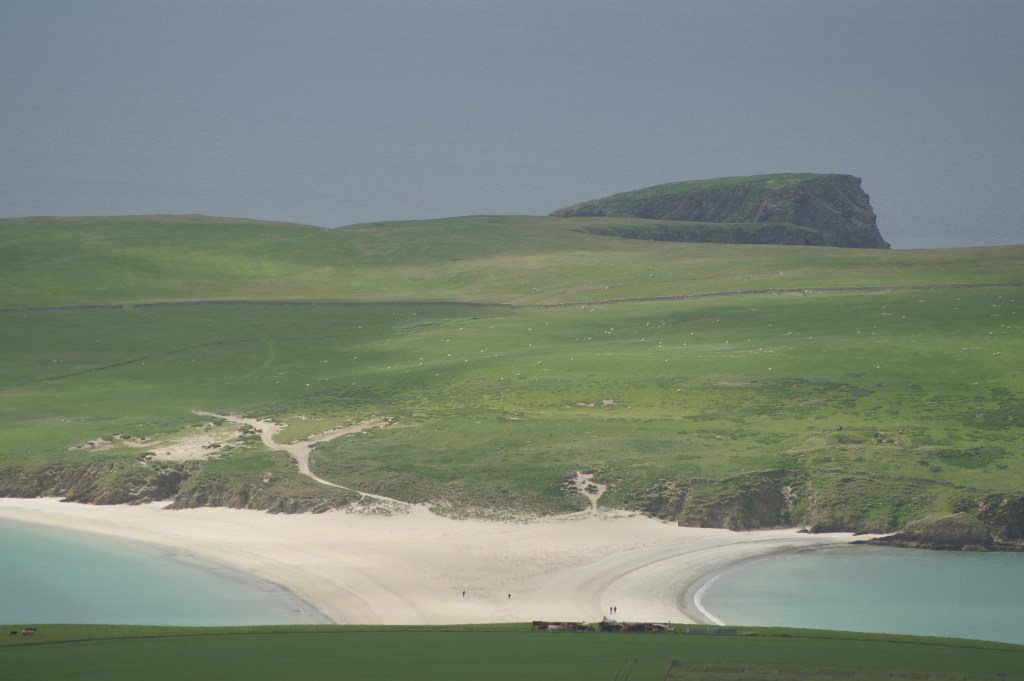
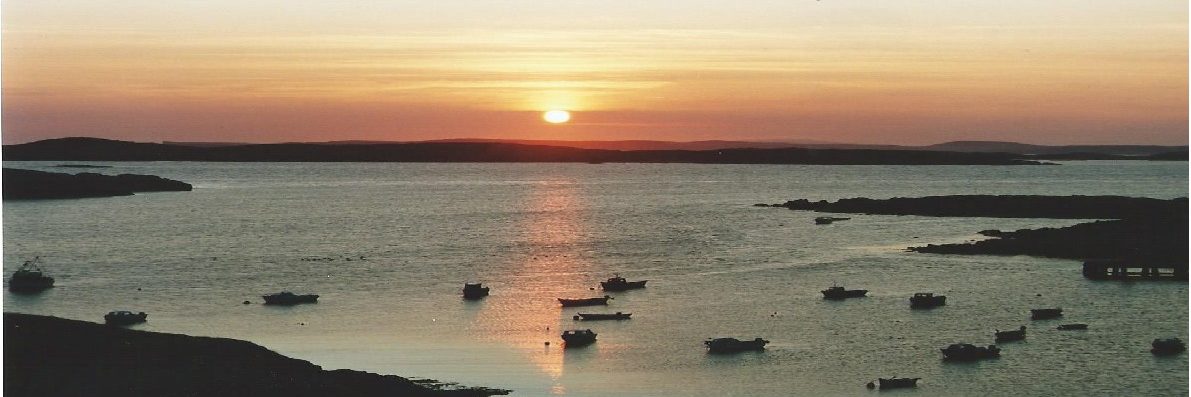
Clift Sound Looking South to Trondra, Burra and the Clift Hills

We waited until the coast was clear and “borrowed” a small boat from the Easter Dale beach, rowed out between Burra and Trondra and south down Clift Sound. We landed on a beach directly below Holm Field; 290 meters high. As we began our climb we passed by what looked like the remains of “planticrubs”, a small circular dry-stone enclosure for growing cabbage plants.

Remains of the Planticrub at the Base of the Clift Hills

After some serious climbing which took around an hour we reached the top. The panorama took my breath away Burra Isle and the surrounding isles lay below us like an open map. We spent hours looking for the aircraft wreckage with no success. Our exploration was cut short when we noticed the sea had changed it was now producing white capped waves and it was coming from the direction we needed to travel back. After some serious rowing and what seemed like an eternity we found shelter between Burra and Trondra and saw in the distance a crowd of people on the beach with my mother at the front and none too pleased!

View from the South End of Burra Isle, Minn & Symbister from Royal Field

It was many years later in the wool store that I discovered how she knew we were there. An elderly crofter on the south east side of the isle was in with his wool clip. “Oliver”, he said, “Did you ever wonder how your mother found out you were climbing the Clift Hills”. “No” was my answer. He smiled and told me had watched us through his binoculars since we had made land, and phoned home. “You had underestimated the tide and wind and indeed you were very fortunate to have made it back safely!” I took the opportunity to ask him what were the remains at the foot of the hill above the beach; they were in fact “planticrubs”. He said they were positioned there by Burra crofters a long time ago as there was a scarcity of suitable ground on the east side of the isle.

Home of the Crofter Who Observed Me Climbing Up Clift Hills

He then proceeded to tell me a story handed down over the centuries by islanders in his district. As was common place throughout the Shetland Islands it was the women folk that did the croft work while the men were off fishing. On a particular occasion a group of women from the south of the island had rowed across and were working in their “crubs” when they were set upon men from the east side of the mainland. In an order to carry out summary justice, the husbands donned women’s clothing and armed themselves with weapons which they hid under their clothes. After a period of time the same offenders appeared and attacked the defenceless women. Revenge was sweet as the intruders were set upon and duly dispatched!

I heard the same story from another crofter from “over the hill” on the east of the mainland, his version was the other way round, the women of his district were attacked. I have my doubts about his story. When Catherine and I climbed Royal Field from the east side and looked down on “planticrubs” not far from his village, why would they travel so far when the enclosures were on their doorstep!

Planticrubs at Catapund, Cunningsburgh

Since that first expedition it had always been a desire of mine to go back to the hills again, perhaps discover part of my youth and find that wreckage. I spoke to a crofter from the district, along with his son, and learned that they had erected marker posts which led you to above the site. A few years ago my wife Catherine and I trekked from the East side of Shetland until we reached the summit of nearby Royal Field 294 meters following the trail. On the western slopes of the hill and overlooking Burra Isle we discovered the remains of the wreckage and the memorial to the crew of the plane that had perished on these slopes in 1944.

Memorial Plaque

The views were indeed spectacular perhaps all the more poignant for me when I thought about my journey from the other side over 50 years before. I now knew why on that first trip we found nothing. I had climbed the wrong hill Holm Field was the neighbouring hill to the north!

On the Correct Hill — At Long Last!
Design & Pattern Support and Added Responsibility (early 1970s)

In the absence of local design and patterns other designers further afield started using some of our yarns in their designs, especially in the U.S.A. Household names at that time which helped spread the word. Closer to home we worked with well- known U.K. designers and if my memory serves me well Sasha Kagan featured our yarns in the Silver Birch Scarf around about 1969. Hunters of Brora provided us with some of their patterns which we could use this would also help them as it could mean more work for them in spinning, the designs were called Broraspun. However we still sought out a local designer without success.

Broraspun Pattern

There was a massive shift in the knitting sector in the early 1970s with the arrival of “black gold” – the oil industry arrived on our shores brining great wealth to the islands. People flocked to work in the highly paid oil related sector, women could be forgiven for casting aside their knitting needles in favour of a much more lucrative income.

Our yarn sales locally took quite a hit and we also lost a recently recruited wool store employee who told me his wage in the oil had been trebled, “Come with me, it’s easy money, not back-breaking work packing wool”.

I was sorely tempted by the offer, especially as Catherine and I were married in 1972. We were very fortunate indeed to acquire our first home together, virtually next door to the wool store and down the road from her parents. By 1974 we were blessed with our first child Claire; followed by our son Adrian in 1976. On the football front I played my first official game for Shetland in 1973, defeating the Faroe Islands by five goals to one in the North Atlantic Cup. Some of the older local football pundits said it was the greatest result by a Shetland team!

Meal Kirk (Church) Where We Were Married in Hamnavoe, Burra (1972)

At work it was obvious something had to be done to make up for the loss of income from local sales. In 1977 we had the good fortune to come into contact with a lady that would change the shape of J & S for ever. Gladys Amedro and her husband had retired and set up home in the island of Yell. Gladys had been a knitter and needlewoman all her life. In their home village of Burravoe, Yell she became a close friend of the late Nellie Tulloch (a native Shetlander who was skilled in the art of lace knitting). She taught the craft to Gladys, and J & S commissioned Gladys to design and help market our yarns.

Glady’s Design

The first design was published in the Woman’s Realm magazine in 1978. Other patterns followed, including a baby robe and shawl commissioned by Woman’s Own magazine in 1988 to celebrate the birth of Princess Beatrice.

Other ladies magazines as well as knitting publications were approached to promote design too many to mention. This new marketing returns made up the lost ground on local orders and yarn sales increased once again. Such was the success of our promotions that another three extra staff were added over a three year period.

Glady’s Design

Not only did this marketing campaign improve the sales of our fine lace yarns it also help create interest in our other woollen spun yarns such as 2 ply jumper weight. Our first shade cards were introduced in the very early seventies.

As a result of all this positive promotions we were approached by many designers, mostly outside Shetland who wished to use our yarns and mostly these would appear in various publications. This once again would promote us and our wool. This was a great help in increasing the volume of business and in 1979 it was decided to build another store this time it meant erecting a building that would fit in between our yarn store and wool store. When asking my co boss Jim Smith who we would get to build it, “us” was the reply it is the “Berry way”

Marketing & Selling – Early Days (1969)

When we received the first delivery of yarn-five shades to start with my introduction to them was in the form of loose hanks, which I had to twist up into a head which comprised of 4 hanks. This was a knack which took a bit of learning; and so began my journey into yarn. Word soon got around that the “Brokers”, the most popular name locally for J & S,  were stocking yarn. The shop was upstairs in the area which had been the balcony of the church I assisted Jim Smith in building a small office and putting in a floor to accommodate the yarn. Shortly after introducing the yarns we had to build a larger shop downstairs to accommodate all the various types.

J&S Shop

I was now called upon to deliver yarn around the houses of Lerwick and to the country bus depot at the Viking car park. Yarn deliveries were also made to the Whalsay fishing boats who would be landing their fish and taking on provisions. Whalsay an Island to the north east of Lerwick was similar to Burra Isle a fishing crofting community its knitters famous for their distinctive Fair Isle garments. The jumpers appeared to stand out above the rest of the fleet and so made it easier for me to identify the vessels (as boats were not my forte).

Comrades LK 325, One of the Last Wooden Drift Net Fishing Boats
Winsome LK 704, Seine Net Fishing Boat

The geographical location of the company on the outskirts of the town and close by the sea front meant it was at the heart of the herring industry and was instrumental in the next major phase in marketing yarns. Many women were required to work in the herring season on the herring stations gutting and packing, squads of women would arrive from the U.K. mainland at the start of the herring season in May and depart the Islands for home in late summer. On a rough day when the weather conditions kept the fleet tied up, local Shetland women who shared accommodation with the incomers would take up their knitting and sell the finished garments. It was only natural that the visitors would take to knitting and make some money whilst being idle on the work place. I remember the distinct rich of mixed dialects echoing through the wool store as they would go upstairs to purchase yarns.

Herring Industry Workers (Courtesy of Mrs Jessie Cogle)
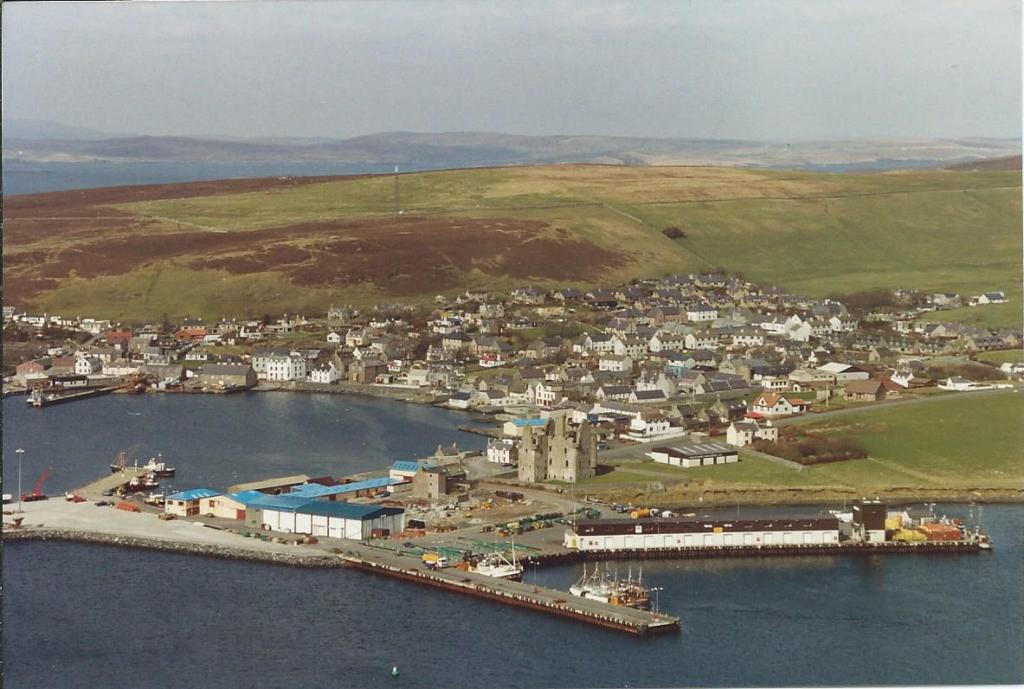
J&S Premises from the Sea
J&S Premises from Above

On returning home to the mainland, they would continue with their knitting and of course would require yarn so in late 1968 we set up a direct mail order to service this demand. Our first mailing list consisted of thirty addresses. I was given the task of filing their yarn orders; my desk was the wool sorting table. Such was the demand through 1969 a lady was taken on to handle all the yarn orders and enquiries. She herself was an avid knitter and excelled in blending colours as well as having her own family’s heirloom lace knitting collection.

Word of mouth played a large part in the early days. Word soon got around that we were providing a yarn service home and away. I am fairly sure at that time we were the only local company selling yarns direct by mail order.  A few local knitwear manufacturing companies would also sell by direct mail as did the cottage industry knitters, the lady of the home, such as my own mother who had their private orders.

Shetland Fair Isle and Shetland lace knitting is an art form a skill handed down through the generations of families in the isles. Patterns were closely guarded and most local knitters could knit complex patterns and colourways from memory, they seldom departed of their knowledge.

This was a major hurdle for the company to overcome in providing pattern support native Shetlanders would be reluctant to publish design at that time. In order to improve direct mail sales we needed a designer!

New Horizons at Work and My Personal Life

I now had the security of a job and I was able to see my family every weekend and soon realised Shetland was where I was meant to be. My social life revolved around playing football for Lerwick Spurs and my home island of Burra. I even played an unofficial game that year for Shetland against the Royal Yacht Britannia. I think the occasion was possibly the celebration of Shetland becoming part of the U.K.  However due to the fact I could not spare another week night off from work in order to attend training sessions, I was dropped from the island football squad.

Burra F.C., 1971

In May 1968 my life was to change forever when I met the love of my life Catherine Manson.She stayed in the big house on the corner just up the road from the wool store. My late mother in law told me she couldn’t understand why Catherine was spending so much time looking out the upstairs window: when she asked, she was told “there is a new boy come to work at the wool store and he cycles to work”! Of course when I asked Catherine if this was this true, she would not give a very straight answer: however I detect a very faint smile! Our first date was to go to St Ninians isle and walk the cliffs on the west side and watch the sunset over Foula, a never to be forgotten experience! We both were so carried away by the occasion that we did not notice the time and arrived outside her home almost an hour later than she had promised her father. He met us at the roadside, my first meeting, and he was none too pleased. The next time we met I asked how she was her answer; “I had a terrible job trying to get rid of the sand in my shoes!”

St. Ninian’s Isle

In June that year I travelled to the Faroe Islands with Lerwick Spurs and had a fantastic two weeks of football taking part in island life and experiencing their culture and heritage. I remarked at the time that their sheep are very similar to ours.

Back home at work in order to grow the company and also add value to the local wool clip we purchased, it was decided to have our own yarns commission spun. Similar to the companies we were currently supplying with sorted wool, and also crofters like my own family who sent their own wool to Hunters of Brora, we would now follow suit. The Shetland wool sorted by us would be held at Brora in a J&S “wool bank” ( meaning the wool always remained the property of J&S). When we placed orders for yarn the wool used would be from our Shetland wool stored at the mill.

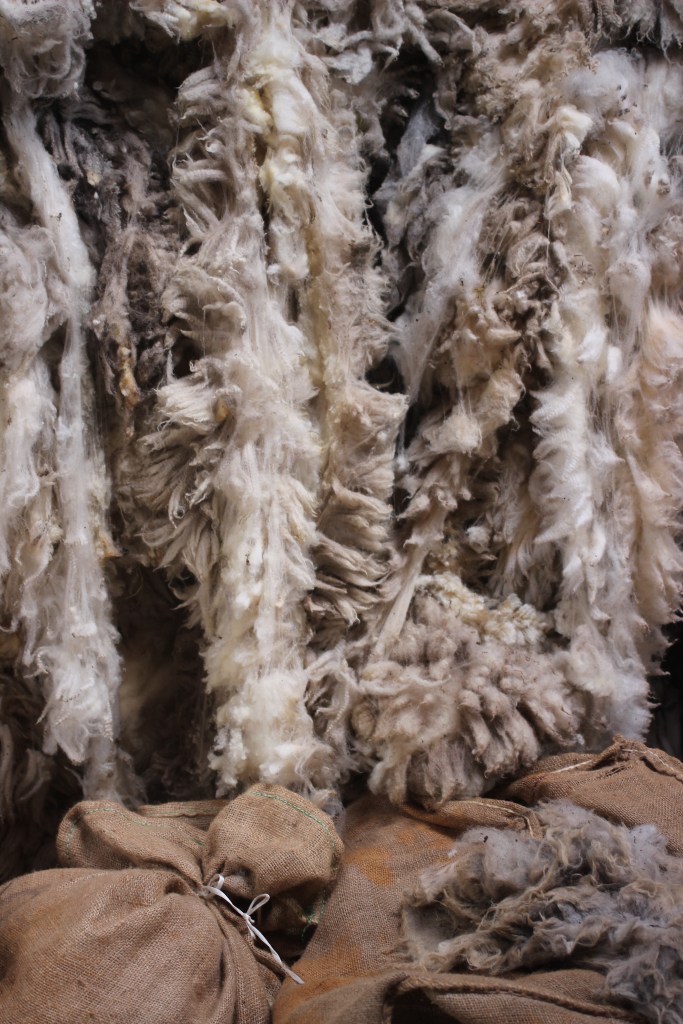
Shetland Fleece and Bags

The standards set in the handling of the wool were very high and followed on to the system that “Sheepie” had introduced when he started out. Firstly the wool had to be from Shetland sheep and not contain any cross bred wool as this would destroy the handle & the fibre would be coarser. At the start of each season we would have a visit from Hunters of Brora senior manager, where he would discuss the level of sorting and if things needed to change.

I fondly recall my introduction in 1968 to the late T.M.Hunter, founder of the Brora mill and his manager the late Tom Simpson, I was ordered to take them in over to the street with Mr Johnstone’s car, as they embarked Mr Hunter asked Mr Simpson to give the young boy two shillings! This was to be the start of a very long and lasting relationship between myself and the Highland “chief” Mr Simpson. Immaculately dressed in tartan trousers they would visit the Islands each year to meet their wool suppliers and users of their yarns. The terms of our association with the mill were set up and J&S wool bank was agreed the greasy wool sorted by us remained the property of J&S and finished yarn orders would be drawn from the wool bank stored at Brora.

Technical knowledge and yarn counts now became an essential part of my everyday life and with the help of Mr Simpson and his staff over the years I began to understand the complexity of knitting yarns and the various qualities of Shetland wool that went to make up these yarns. Due to the lack of uniformity of quality and staple length in Shetland wool hand sorting was the key. The coarser Britch and guard hair had to be kept well clear of the finer wool or you would end up with an abrasive itchy yarn. Mixing together the short and long staple would result in a thick and thin finished spun fibre. As we were dealing with hundreds of clips we encountered all qualities of and types of wool, cross breeding especially with Cheviot was becoming more common in order to achieve a larger more marketable finished lamb. This wool had to be kept apart from the Shetland, if not it would affect the handle, that is the softness of the Shetland which was one of its strongest characteristics and sets it apart from other so called Shetland spun from “foreign” wool.

The first yarns stocked by J & S were the “natural“ shades, Fawn, Moorit, Black, White and Silver Grey and were 2ply jumper yarns. These were the most popular used by the locals at that time and were used to make Fair Isle garments. The main part of the jumper consisted mostly of Fawn and the Fair Isle Yoke pattern was made up of the other natural shades. Once the word went around we were now stocking yarns the demand grew and in a very short time the amount of shades increased, and also other weights/types of yarn.

First Yarns on Hank

The list of woollen spun yarns supplied to us by Hunters of Brora was quite comprehensive and were yarns that the mill had been producing since 1901.  

Yarn counts “the Gala count” we started with, it is important that each mill had their own version of yarn counts Hunters as our spinner had their own standards.

A cut was a hank of yarn.

1/36s 1Ply Cobweb = 16cuts = 1lb from the finest wool. Hand knitting equivalent = single ply.

2/36s 2Ply Lace = 8cuts = 1lb as above. = Hand knitting equivalent = fine 3ply

2/28 Spencer = 4 cuts = 1lb of the finest =

2/24 Hap = as above.

2/21s Jumper = 4 cuts = 1lb Fine wool. = Hand knitting equivalent = 4ply

2/18s Jumper = 4 cuts = 1lb Fine wool = Hand Knitting equivalent = 4 ply

2/9s Brora Soft Spun = 4 cuts = 1lb Fine wool= Hand Knitting equivalent = Hand Knitting Arran weight

3/ 18s = 3Ply = 4 cuts = 1lb Cheviot & Cheviot Cross wool = Hand Knitting Double Knitting

3/11s = “ Embo “Heavy = 4 cuts = 3lb. Coarser wool & Shetland Britch = Hand Knitting Chunky

4/7s = Unst Fleece = 2 cuts = 1lb. Heavier wool = Hand Knitting equivalent = Heavy Chunky.

I will talk more about the technical side of the above yarns in a later blog, and provide further explanations.

Happy Memories of Island Life from My Childhood

When I was around about 10 /12 years old I would often go off to the fishing with my Grandfather in his boat the Betsie. Most often we would fish off- shore to the North West of our Island home Burra. An event that remains with me to this day is that instead of heading north we ventured to the south and after some time came into the lea of an Island which he said was called Havera. Our fishing ground was known as the Trink and in no time we caught more than enough fairly large haddock.

Havera from Top of Royal Field West Cliffs, Cunningsburgh

Seeing we had a bit of time to spare he guided the boat into an enclosed inlet or as we knew it a “geo” and we embarked on a rocky point. We toured the Isle and he told me stories of crofter/ fishermen who had lived here when he was young and stories of ship wrecks.

Havera Houses from the Ness of Ireland

If my memory is correct one of the last families left the Island and settled on the south east of Burra at Symbister. The soil on Havera was very fertile and at one time supported several families. Grandad told me of a rich vibrant Island surrounded by bountiful fishing grounds, incomers would come in to the isle and work in the fish drying and salting.

When we reached the ruined settlement I was astonished to see the houses set out on a promontory and flanked by deep cliffs very dangerous indeed. He went on to say a story went around that the smaller children were fastened to “tethers” rope, to keep them from falling over the edge.

Havera Houses at Cliff Edge
Ruins on Havera

That particular day one question was answered the broch type building at the top of the Island which I always believed it had to do with Picts, it was in fact a windmill which seemingly did not have a lot of success. Not only was this day a successful fishing trip it was a journey back in time tales from someone of that era, and a day I will never forget.

Havera Windmill
Gathering Sheep at Havera
Loading Sheep
Securing the Sheep Aboard the Boat Before Leaving

Many years later an elderly crofter from Hoswick on the east coast of Shetland told me his mother had gone into Havera to work in the fish and she spoke about dancing Shetland Reels in Havera. Yet another crofter from Sandwick told me of a laird’s man going into Havera to gather taxes, on his way back to the shore he was left on a rock and succumbed to his fate and drowned.

I was most fortunate to visit Havera again and the surrounding district this time with my camera.

My Introduction to the Wool Trade

When I began at Jamieson & Smith Shetland Wool Brokers in July 1967, my place of work was the main wool store part of my job was to carry in wool sacks from the crofters and farmers who would park their vehicles outside the front door on the main road. At this time of year it was the start of the wool season and clips came in most days, including my first day so it was hands on immediately. The sacks were weighed in on a large scale situated inside the door and the clips recorded in a purchase book. Each bag was numbered with the crofter’s identification number which was kept in a wool producers log book. On completion of weighing the clip the producer was taken in to the office, the price agreed and paid by cheque. This prompt payment suited the crofter it was their first produce sale of the year and a boost to their finances, it was also a day out in the town. Some were very vociferous having called in at a number of hostelries on their way home. Two brothers from up in the north of Shetland, travelled in with their wool clip in a small three wheel van. Returning home later on at night only made it to the first turn off out the North Road where they capsized. Nearby residents met them exiting the vehicle unhurt but confused as to why they were still in town. They said they had been in selling their wool clip!

The method of arriving at payment was fairly straightforward the customer had the previous year’s transaction kept on record under their allocated number which was recorded on an index card stored in a metal fire proof box. Details of the previous years’ purchase number were kept there and it was a case of finding last season’s clip and the price paid. There was also a report on how the clip had graded out. At the start of a new season a price was agreed with the merchants who bought the wool from J & S. If the wool price had changed the price would be added or deducted from the previous year’s price. Some of the sacks were sewn up and were shipped as they had come in with the identifying number shown. When the wool was sorted at the other end a report was then sent back on how the clip had sorted out meaning an accurate valuation of the wool could be applied. Very straight forward with one flaw you- were working one year behind. Not all the wool was sent away a lot of it was kept to be hand sorted by us and sold on to various mills and textile companies and knitting manufacturers in Shetland as well as mainland U.K.

Wool Grading

If a new customer should arrive their wool would be evaluated. I recall one instance where a crofter came in and his clip was to be examined and a price set. The boss Mr Johnstone went through the sacks emptying out the wool on the floor and then announced what he was prepared to pay.  This was met with disdain by the crofter who demanded more, this was met with a firm “No”, where by the transaction became “heated” to say the least. The upset crofter said he would take his clip away and said, “You dumped my wool out, you pack it up” and another argument ensued at this point I risked going in between them and packed up the wool myself then helped the crofter carry out his sacks and went back inside where I was met with a firm “If you are going to work here you will need to toughen up with these crofters“, that same crofter came back a few months later sold his wool and all was well!

The classing system was fairly straight forward; the bulk of the wool was from Shetland sheep and so was called Shetland, Cheviot and Cheviot Cross Shetland, Heavy & Blackface, and Rough Shetland. Coloured wool grades were Fine & Rough.

Sorted Shetland, where we hand sorted each fleece separating the various qualities was divided into No 1 Shetland & No 2 Shetland, and Strong, that was the Britch & guard hair we separated.

Lamb on a Rock at Symbister, Burra

The sorted wool was kept in bins/enclosed areas along the wall and then packed into jute bales which were hung inside a wooden scaffold. One of my tasks was to pack the wool pressing as much wool as possible into the bales as possible. This practise thankfully ended in 1970 with the arrival of a new wool store and mechanised wool press.

Wool Press at Workplace

With the introduction of wool bales my workload changed, especially the shipments. The smaller wool sacks were of different sizes and each bag had to be labelled, indexed and sewn up. Stowing the sacks on a flat-bed truck for its journey of about a mile to the harbour and securing was a nightmare; it was seldom a load would reach the quayside intact. Unloading the truck the sacks were shifted directly into a cargo net and winched aboard the ferry, quite a few sacks would slip into the water and be returned to us. Mr Johnstone would vent his anger on the stevedores and P&O Ferries shipping manager.

Shipping Wool Bales in the Early Days

I found the job to be hard work, but it was very interesting meeting the crofters and listening to their stories from the length and breadth of Shetland. There were many special characters my first meeting with such a person was unforgettable. I was on my own when this crofter came in the store saying he had a message for a crofter up north and could he leave it with us. I agreed to this and accompanied him out to his vehicle a small van. He went into the back and handed me out a rope which I was most shocked to see was attached to a fairly large horned Shetland ram. I was left speechless standing on the road with my new friend, the crofter said before driving away, “He will pick it up after 5pm, no name.” I tied it alongside the store to a telegraph pole and when Mr Johnstone arrived and saw the animal, he was none too pleased. The ram had gone when I arrived for work the next morning!

Young Ram and Dog

The wool season passed by fairly quickly and the wool came to an end, I was preparing myself for being made redundant. Thankfully I received a pleasant surprise from Mr Johnstone. “You are not to be paid off. The old boss, ‘Sheepie’ wishes to keep you on. You will work on Berry Farm during the day unless you are needed here and you are to work some nights at the sorting table with me and learn about wool.”

I was quite delighted by the news as was my family, I would not be returning to the U.K. Mainland. That was not the end of the good news I had the use of our family’s summer caravan in Lerwick and had just passed my driving test and had the use of our family car. What more could I ask for!

I will deal in more detail about wool in future blogs.

Moorit Face

My Workplace at the North Road, Lerwick in the 60s

On the Monday morning of the 17th July 1967 I set off on my bicycle from my new home (a small caravan on the south side of Lerwick), travelled north across town and arrived for work at the premises of Jamieson & Smith situated on the outskirts of Lerwick on the main road out of town.

My First Home in Lerwick

I was met by the manager, Mr Gilbert Johnstone, and he showed me around and told me what would be expected of me in my position at work. The main building itself was of corrugated iron with huge windows. My first impression was that it resembled a church and I soon found out that in its past it had indeed been a United Free Church, officially opened in 1914. The North Roadside Church, as it was known, had been a place of worship for the herring fishing community of Lerwick, the capital and main port of Shetland. At the peak of the herring season it was said the church could seat 450 people with fairly high attendances special services were held for the Gaelic speaking herring workers in the evening.

Northroadside Church in Background (courtesy of Ella Gordon)

I was most fortunate to meet up with two individuals with first- hand experience of the church as it was. In 1973 an elderly gentleman came in the wool store and looked around, I enquired could I help him? He answered in a broad north east of Scotland dialect; “you are alright, and I am just having a look at where we were married.” It was in 1913 that he had married a lady from the south end of Shetland, the daughter of a fisherman. He told me he had been a fisherman, and had travelled to Shetland following the herring.

The second instance was an elderly man I met outside the store that told me as a child of four he attended the “Tin Kirk” Sunday school. His particular memory he said was of singing a solo hymn at the Christmas service, I will make you fishers of men. He looked at all the faces and burst out crying- his mother had to rescue him.

Packing Herring at the Herring Station (courtesy of Ella Gordon)

The herring industry, although on the decline, was still a major employer and along the shore were herring curing stations. At the back of the building were the gutters accommodation and overlooking the herring stations on the more raised north roadside the “cook” house a huge black wooden shed where the workers meals were prepared. A vivid personal memory of the cookhouse was one summer morning in 1969, a distraught herring worker came rushing into the wool store shouting in a strong north east coast accent “Can you help us our cookhouse is on fire“ I set off with our fire hose toward the cook house but could only reach half way. I ran back for a fire extinguisher and met the fire brigade who quickly put out the blaze.

Shearer’s Station (courtesy of Ella Gordon)

At the back of the main wool store, were three smaller buildings. Two where coopers had made wooden barrels which were used to pack the herring and now used as garages. Access was by a smaller road which branched off the North Road; at that time in 1967 was the main road out of Lerwick. A larger corrugated building which housed the toilet, had served as a police station since 1905 till 1935. It was called the North Road Station and back then contained accommodation for a constable the last occupier was Constable Archie Nicolson and his family. Constable Nicolson was reputed to have been the last wielder of the birch in Shetland and this was issued to a Lerwick fisherman, his crime he stole a loaf of bread! This building was now used for general storage. The building was altered in 1936 and became herring workers accommodation.

In the summer months the herring stations were a hive of activity, the neighbourhood resounding to the rich dialect of the herring workers who mainly hailed from the North East of Scotland. Sadly by the early 70s this way of life changed due to more modern fishing practices such as the purse netting.

Directly behind the premises was a herring station formerly Palmer & Thompson. The station had recently changed ownership and the new owner lived in one of the older gutters huts his access was by the same road as the J&S buildings. He intended to sell the land to developers keen to establish a presence close to the sea front. This was my first signs of changes in the area and the herring industry I had come to know it, as the son of a herring fisherman.

My work place was a fairly large open space with a small office at the foot of wooden stairs that led to a balcony. The seating church (pews) had just recently been removed and looking out into the interior you could see the signs on the far wall where the pulpit had been. Before becoming the home for wool, in the early 1960s the building had been an auction sale room for which it was ideally suited.

Papa, the Island of the Priest

When I was very young, and before the bridge to my home island of Burra was built, we would travel close by Papa in order to get to the village of Scalloway and the bus on to the town of Lerwick. A day out with our family in the summer months, in the absence of cars, was usually a trip to the smaller isles in my grandfather’s boat the Betsie. Occasionally, we would observe people gathering sheep on Papa; usually in the summer months, Grandad would say that’s ”Sheepie” from Berry Farm. Strange to think that in the future I would be chasing around the isle after those wild sheep!

Papa Sheep Pens with the Mainland in the Background

Papa is a small island of 148 acres situated in a group of Islands of the west coast of Shetland approximately a mile from Scalloway, the ancient capital of Shetland. Papa is typical of the smaller islands which total around one hundred and help make up the Shetland Islands. The name Papa means “island of the priest” and could have been name after an Irish priest resident on the island centuries ago.

Papa is now uninhabited, although it is recorded that in 1891 the population was 23 and the last residents left before 1931. In the 1800s to early 1900s crofters and fishermen stayed in the islands and in the fishing season extra men would stay over going to the fishing with the isles men and helping dry the fish on the beaches.

Papa Croft House Ruins
Slater Plaque in Memory of Past Family residents

On the west coast of Papa is a small inlet called Tangy Voe, situated on its shore is a ruined church called the “peerie kirk” (small church). It was here that people came by boat from the neighbouring islands of Hildasay, Oxna, Havra, Linga and Langa to join the Sunday worship. An elderly neighbour of ours  told me he rowed from Hamnavoe to Papa one Sunday morning to attend the service, he said the lady playing the organ was called Mary O Papa, her surname could have been Goodlad. My great granny was born on the neighbouring Island of Hildasay then moved to the smaller island of Linga. No doubt, she too would journey by boat to the Peerie Kirk.

It is said the residents of Papa would place a bible on a sloping rock, visible by spyglass from nearby Oxna. This would signify the arrival of the minister from mainland Scalloway. The residents of Oxna would then notify the neighbouring islands perhaps by waving a bed sheet from a hilltop close by.

The closest island to Papa is Oxna just across the water as seen in my image; there was a small hillock on Papa overlooking their neighbours called “The Crying Knowe” it was here that the residents would shout across the water to one another in the absence of such things as a mobile phone!

Peerie Kirk with Bible Rock
Peerie Kirk with Oxna and House in Background

There were few families in Oxna.  According to my great grandfather, Oliver Goodlad skipper, of the Emulator in the 1930’s (his notes on boats dated 1906), there was a vessel called the Leaping Water recorded in Oxna, a sail vessel of perhaps 40 feet, the owners L.F.N.Garriock skipper J.Fullerton. No doubt crewed by men from the surrounding isles.

I will deal with the sheep and their husbandry in a very interesting blog a bit later on which shows the importance of Papa to the Smith family of Berry Farm.

John “Sheepie” Smith, My First Employer

I returned to Shetland in the summer of 1967 fresh from Agricultural College. However, if I wanted to pursue my choice of career in farming I would have to return to the mainland. There were few jobs back home to be had other than the fishing sector and for me that was not an option. A friend of my parents said there was a job going at Jamieson & Smith Shetland Wool Brokers based in Lerwick for the duration of the wool season which would be the end of September. My employer would be John “Sheepie” Smith of Berry Farm, Scalloway and one of Shetland’s most highly respected businessmen. He had been involved with wool since the 1930s and dealt in all types of agricultural produce. He had started his working life as a crofter with one park in his native parish of Sandwick. His father James Smith was married to Isabelle Jamieson. Perhaps a clue as to why the company always retained its name!

John “Sheepie” Smith

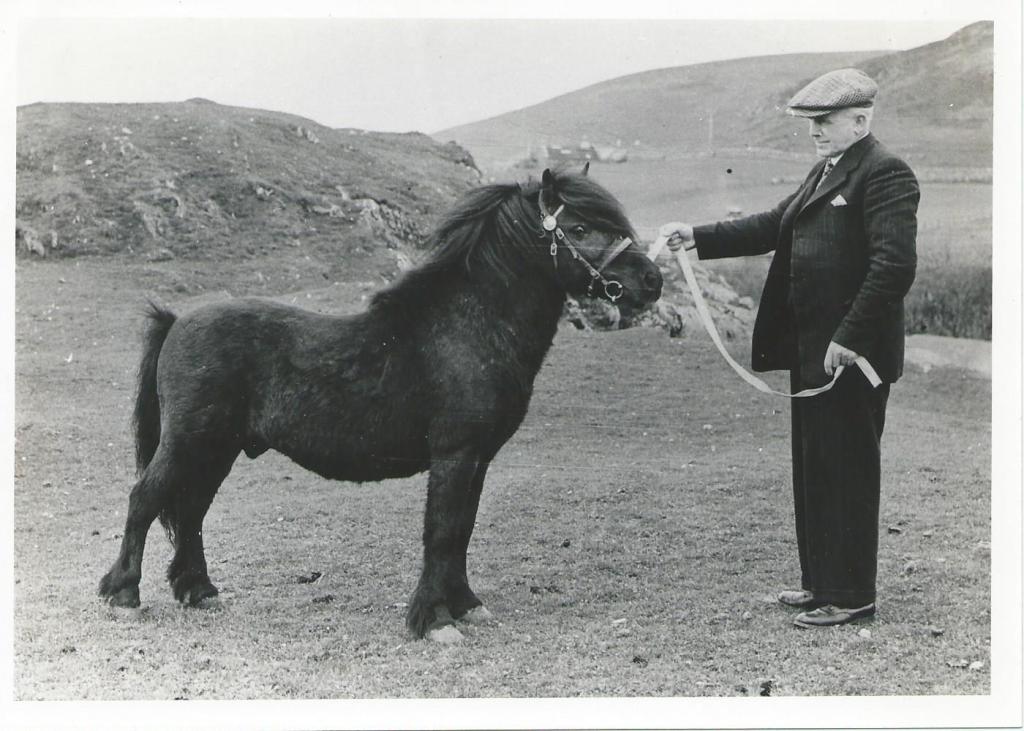
Berry Farm is a very fertile farm with green fields and sheltered from the North wind by Berry Hill. It surrounds the village of Scalloway with its ruined castle once home to the infamous Patrick Stewart, Earl of Orkney, Lord of Shetland one of the most notorious figures in the history of the Northern Isles. Berry Farm had a herd of Aberdeen Angus cattle, larger cross bred ewes and in the hill were Shetland sheep.  They also had the island of Papa,lying off – shore from Scalloway, with a flock of smaller native Shetland sheep that survived quite naturally Pride of place on the farm was the Shetland ponies that made up the Berry Stud book famous for its breeding of the miniature pony. The farm workers did not share this love of ponies as they would constantly lean against the fence posts causing them to break and extra work in replacing them.

Scalloway Surrounded by Berry Farm
Berry Farm

The Smith family also owned a large Island between the islands of Fetlar & Unst, called Uyea stocked by the larger cross bred sheep. They also had grazing rights on another smaller Isle near Papa.  In 1933 John Smith purchased a large farm on the outskirts of Aberdeen, (Pitmedden farm) where he would send livestock from Shetland in order to fatten them up and conveniently wait on a favourable market. This was a luxury we do not have in Shetland due to lack of grazing.

The wool handling at Berry Farm was an important part of the family business. Shetland wool was much sought after at that time as was most natural fibre, man- made fibres had yet to come to the fore. Wool brought in good financial returns and also served another more practical purpose at Berry Farm. In the inclement winter months there was little work to be done on the farm. In order to retain his valued work force John Smith had his workers hand sort the wool into various qualities and then sell the sorted wool. This kept his workers employed till the spring and more favourable weather.

John Smith’s knowledge of animals was legendary throughout the U.K. In 1928 he shipped off two Moorit rams to the Castlemilk estates these rams were to play a major part in the establishment of the breed Castlemilk Moorit flock.  An older friend from the Island of Yell in the north of Shetland told me as a young man he was asked by a local merchant to run “sheepie” around the crofts to buy up stock. Running out of cheques he told the young man to go in the shop get some brown paper shop bags where on them he wrote out I.O.U.s to the crofters. Every crofter received their payment on return to Berry Farm, a measure of the man and how he conducted his business.

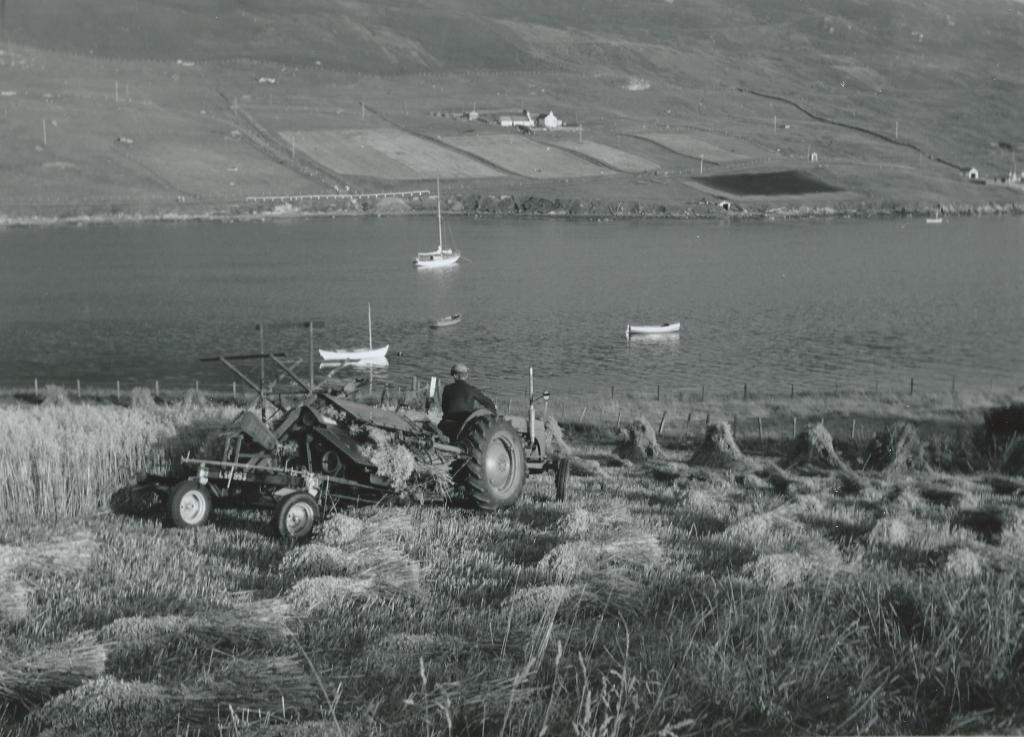
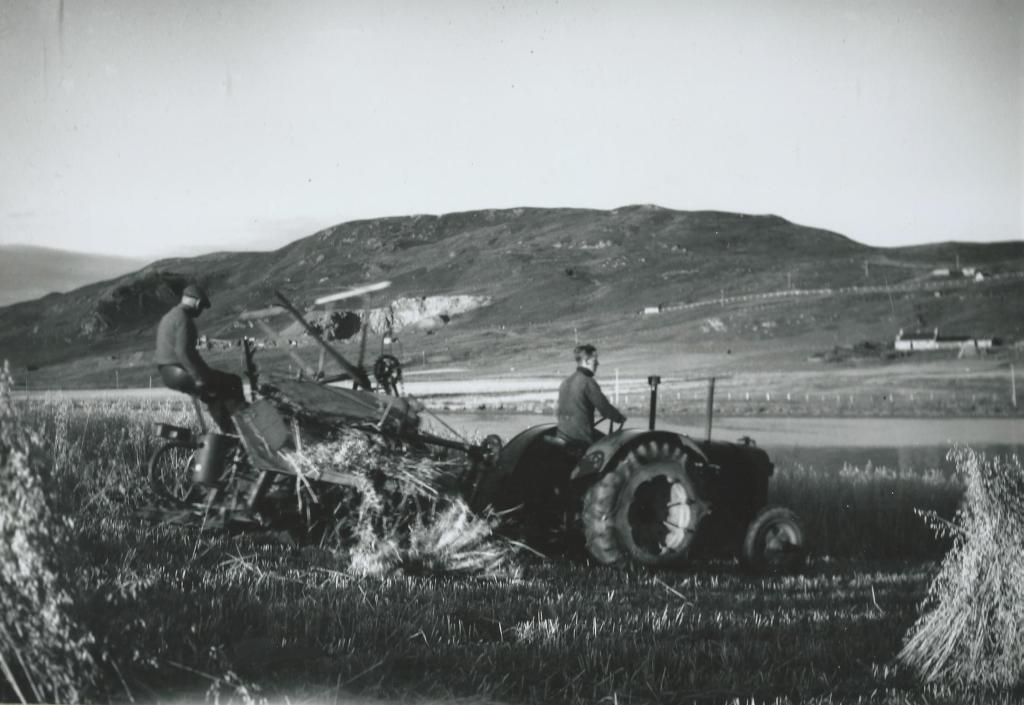
Harvesting Corn

I recall my first contact with John in 1967 at Berry Farm and all his questions the first one being about how I ended up becoming involved in agriculture coming from Burra Isle, as most men were fishermen. Perhaps he was sizing me up, as later on he employed me full time and I had taken the correct path after all. Only time would tell! Sadly John Smith passed away one year after I joined his company. His son Jim and daughter Eva took on the running of his companies.

Stooking Corn
Baling Hay

North of Scotland College of Agriculture

It was in August 1966 that I arrived in the outskirts of Aberdeen at Craibstone Agricultural college along with fellow Shetlanders Michael Blance and Peter Farmer. Looking through my diary a journal we had to keep and record all our visits and lectures, in my entry “First Impressions of Craibstone”; stated I was amazed to see such a modernised College I expected a dormitory of about 15 boys but the living quarters were quite good, I shared a room with Peter Farmer. The sports facilities weren’t good; however there was a very good tuck shop”! I think that opening entries sums up where my priorities lay! The time table of work consisted of general practice farm work the only animals missing were sheep! There were also agricultural related visits which were supposed to cover all aspects of farming however still no sheep! Class work was in the afternoon and lectures were held at night has again covered farming in general, there were two lectures involving sheep,” Management of a Ewe Flock” and a talk and demonstration by the British Wool Marketing Board this was when I was first told that along with the Isle of Man we in Shetland were excluded from the wool marketing board! I gave that little thought at that time although I would have imagined Shetland wool producers would like to be treated similar to the U.K. mainland wool producers and received government subsidy on their wool clip.

On asking the lecturer and expert on “Management of a Ewe Flock” on his impression of Shetland sheep his reply was “of no commercial value, a bag of bones although good mothers”. No mention of the fine wool perhaps because we were not part of the Wool Marketing Board and he had no experience of the Shetland wool clip!

Day Off at Craibstone

The course consisted of systematic lectures and tutorial classes as well as practical instruction in seasonal farm operations. Agriculture including Crop and Animal Husbandry, Farm Machinery, Surveying and Building Construction, Farm Management, Organisation, Accounting and Animal Health. In the summer of 1967 the dreaded day arrived, the start of our final exams on the fore mentioned subjects for me “two weeks I would never ever want to repeat, perhaps if I had spent less time socialising, playing football, and supporting Aberdeen F.C. I would have fared much better in my studies!) However, I was most surprised to receive a pass mark and, looking back, this was also more rewarding considering my humble island background which could not even boast a tractor.

Craibstone Graduation (I am at the End of the Second Row – With a Lot of Hair!)

My two years up I journeyed back home on the north boat the, St Clair, in the summer of 1967 unsure what opportunities await me, wondering like many young people who left the Isles I too would return back down south to seek employment as there were few jobs available back home.