Further Education and Douneside

Leaving secondary education in Burra Isle was a very sad day for me I was to travel by ferry and bus a journey of 2 hours, to Lerwick it was a total change and so I found myself in the wider world, I realised gone was the security of Island life where you knew everyone. The town appeared huge and most of the people complete strangers. I stayed with a Lerwick family as a lodger Monday to Friday and would look forward to Friday and returning home. Schooling was also different class sizes were huge in comparison to what I was used to, and I took time to adjust. However after only one year I received word from the education department that I had been granted a place at the Agricultural College at Aberdeen.

In order to attend the college it was necessary to have one year of hands on experience by working on a large farm and as there were no suitable opportunities available to me in Shetland a list of farms was sent to me I chose MacRoberts Farms, at Douneside Tarland in Aberdeenshire, home to a pedigree herd of Friesian dairy cattle. Douneside was one of the many farms belonging to the MacRoberts Trust and was situated in the beautiful Howe of Cromar on Royal Deeside on the edge of the Cairngorms National Park and close to the idyllic village of Tarland.

Howe O’ Cromar; My First Sighting of Douneside
A Cow on My Side of the Byre

I stayed in a bothy next door to the byre, it was quite basic with two rooms a toilet no bath and only an open log fire for heating. Our meals were prepared by the cattleman’s wife and were one of the major pluses of life on the farm. My working day started at 4am when I made my way to the byre to be met by a herd of black & white cattle trooping in the door in almost military fashion. Each one knew its place in the stalls and only had to be secured, it was indeed a far cry from my early memories of the Tait family’s single cow back home in Burra some shock to the system! I was shown how to feed, wash and prepare each cow for milking and on my side of the byre. I was responsible for the care of 35 cows. Although the farm work was very hard it was also very rewarding. There was a mixture of general farm – for instance I found my first experience of driving a tractor a daunting task. As the seasons changed so did the work schedule approaching winter the cattle would be kept in the byre, thus creating more work, cleaning and feeding silage and food concentrates. My pay would be £2.10 shillings (todays value £44.00) food and accommodation were free, and I was given overtime pay when working nights. It was a seven day week with a weekend of every month.

Courtyard with Silo Tower Where We Kept Our Silage

The little social life I had was spent in the hills and woods, Dad shipped down my bike so I had great times exploring Royal Deeside the highlight being climbing Morven a mountain just short of 3,000 feet. The views from the top were breathtaking and in the distance I could make out Douneside nestled in the hills distinct because of its silo tower. On returning back in the early evening I was met by my boss, Norman Anderson the head cattleman, he had received a phone call from a neighbouring farmer about one of his young ”loons” (boys) climbing Morven. He said, “you don’t have mountains in Shetland! People are known to get lost up on our mountains!”  It was my first and last mountain although perhaps he was correct, maybe I could still be there roaming the mountains as a young Highlander, as written by a previous fellow adventurer of the region the illustrious Lord Byron who penned one of his poems inspired by Morven, “When I Roved a Young Highlander”.

Posing Hunting

A year flew by and it was with very mixed emotions I bid farewell to all my friends and fellow students and caught the bus to Aberdeen and then the ferry back home to Shetland; secure in the knowledge that my journey to Royal Deeside and Douneside would never be forgotten.

My Early Years with Shetland Sheep & Wool

My grandfather’s croft consisted of a small park which was fenced in where he kept perhaps a dozen ewes. The remainder of his flock roamed the village. I fondly remember hand feeding his sheep especially in the winter when grazing was scarce. One particular Shetland ewe “Blackie“ would come into our house and I would brush the snow off her fleece while hand feeding her. As Island life was predominately based around fishing the crofts and sheep numbers were relatively small, the returns from crofting were sparse, and livestock was mainly used to supplement the needs of the family. This included their fine wool.

Mam, My Sister, and Blackie at Hamnavoe

It wasn’t until I was 10 years old and had the good fortune to meet up with my Uncle Willie Robertson’s family, who lived in the North East of Shetland in Vidlin, that I came to understand the importance of traditional crofting life its impact on a rural community and the comradeship of crofters. My summer months were spent on the Robertson croft at Kirkabister in Vidlin and it was here my education of Shetland agriculture and in particular Shetland sheep and wool began.

Vidlin Hills

A highlight of my summer was gathering or “caaing“ the hill sheep. As many as a dozen crofters would set off with their dogs from different parts of the district, which was very hilly and full of gullies and burns. I marvelled at how they all seemed to meet up at a certain location, most often next a loch, and drive the mass of sheep into the “cro” (pen). Here each crofter would select out their own sheep and start hand shearing or in some cases “rooing“ (plucking) their animals. I began to know how each crofter could distinguish who owned the sheep. This was done by “lug“ earmarks, where each crofter had their own “brand“. A favourite memory of mine was at one of the larger gatherings, I spotted one of the Robertson family’s black ewes being shorn by a distant neighbour and telling the Johnson brothers, who were representing the crofter who owned the ewe of what was about to happen I asked if they should point out the mistake they said no just wait and when the crofter had finished, they went and said thanks for shearing one of the Robertson sheep and took the fleece and handed it to me to pack!

Shetland Sheep in ’60s (courtesy of Morag Hay)

In Vidlin I learned the art of shearing the sheep by hand and also how to “roo” the fleece off the sheep. This was fairly easy with the Shetland sheep as in the summer months the new wool would rise causing the old wool to lift and making it easy for the wool to come off the sheep. Having exceptionally fine wool made it easy for the sheep to shed its wool and in many cases when the sheep put on condition it would make this easier to happen. Crofters entering a sheep, especially rams at a local agricultural show would “roo” the sheep giving it a better finished coat much more even in the staple. People used to go and gather the “cast off” wool known locally as “hentilagets” and sell it or trade it for yarn.

Boy with Ram Before “Rooing” (courtesy of Morag Hay)
Father and Son “Rooing” Ram (courtesy of Morag Hay)
Boy Feeding Lamb (courtesy of Morag Hay)
Dog with Two Lambs (courtesy of Morag Hay)

I am very grateful to Morag Hay who was brought up in a farming and crofting environment and involved in agriculture all her young life for most of the images accompanying this blog it shows her families involvement with some aspects of sheep husbandry in the 1950s/60s.

Oliver with Lamb on Family Croft, 1969

Hosiery Companies

There were many hosiery companies in the 1950s/60s so the knitter was spoilt for a choice sadly there are only a few left today.

Our neighbour Jessie Cogle’s family owned one such hosiery business-P.T.Robertson – called after her father. I was fortunate to work with Jessie at Jamieson & Smith at the end of the 1960s.

I am very grateful to Jessie for allowing me access to her family photos and archives and her knowledge of how a hosiery business was run in the past, this was fairly typical of the knitwear trade at that time. P.T.Robertson initially had a business on the Island of Whalsay; a fishing, crofting and knitting community. In 1950, P.T. moved to Lerwick where on he continued his hosiery business albeit on a larger scale. Jessie started work in the business at the age of 15 like most girls of her time knitting was a way of life and Jessie at an early age in Whalsay was a very experienced knitter. Not only did she knit and help run the family business she doubled up as a model displaying the garments purchased by her family business.

P. T. Robertson Shop Premises
First Motor Vehicle in Whalsay

Marketing of the knitwear purchased by the company was vital seeking out markets involved travelling out-with the Shetland Islands. In days gone by the visiting hansietic merchants especially the Dutch involved in the herring reputedly bought a lot of knitting especially fine lace. P.T.Robertson’s first venture is recorded in the attached archive material.

Staff at P. T. Robertson
Press Release
Selection of Various Knitwear

Of course hand-knitters in Shetland also had their own markets and orders out with the Islands. Mam would reply to adverts in publications such as the Peoples Friend and Sunday Post and established her own contacts. I was very fortunate to inherit her order books which makes very interesting reading and was an example of a cottage industry carried out in the home which was common place at that time. It is a very detailed account of how a knitter of that era conducted their business .For example In September 1964 mam received an order from John Morrison ( Highland Outfitters ) Ltd, 461 Lawnmarket, Edinburgh Caledonia 8149 which could be the telephone number? It was for a 44” lumber at 45 shillings – £2.5 shillings todays value = £39.10p. Morrison is her main market; another buyer was W.S. Robertson 13-15 High Street, Hawick, Roxburghshire.

“ Makkin”( knitting) the garments was mainly done by Mam but for a larger order of Fair Isle Yokes she was assisted by my granny, Janie and my younger sister who learned to knit when she was four years old and by the age of thirteen was helping Mam with her hosiery orders knitting in Yokes, finishing garments and sewing in buttons. This was fairly normal at that time in a lot of homes throughout Shetland the women would spin, knit and carry out the croft work while the men were off fishing. In most homes the man of the house would be able to work on the hand frame knitting machine and the woman would knit in the Fair Isle. In fact when we first married my wife Catherine would knit on the machine but lost patience with me when I attempted to learn I was far too heavy handed my garments and would come out in holes!

Trip Away

Well, what a weekend it has been! After a very busy week in Edinburgh for the Wool Festival last month, I have had a very enjoyable few days break in London what could be described as an unexpected football bonanza; something I have dreamt of since I was in my teens.

Football has always been the other great passion of my life (besides wool, of course) and I have been an ardent Chelsea fan since the mid- 1960s. My home island, Burra, in the Shetland Isles formed a football team, our father was one of the stalwarts of the move to create it so it was always close to home, and as we were a small community of perhaps 500 people there were not many football facilities. Despite this, when I came home for the summer of 1966, my dad had written to Chelsea football club and obtained a second hand Blues training football kit. I had the honour of playing for my home island that summer and, in subsequent years, donned that famous blue strip. At that time I also played for Lerwick Spurs and a teammate of mine, Jeemie Tulloch (who had been at Aberdeen F.C. as a youth), would tell me stories of his sharing accommodation with the famous Chelsea and Scotland football legend Charlie Cook, so it would be fair to stay I felt connected to the Blues!

Come Christmas last year, imagine my surprise when our son, Adrian, and his wife, Sarah, presented me with a 2019 Chelsea calendar for my Christmas present- attached to a match-day museum package including tickets for a Chelsea home game in April 2019! It is difficult to explain how this felt; other than it was like being a child again and receiving my first ever Christmas present from my parents.

Arriving in London, we were staying in a hotel attached to Stamford Bridge. Words failed me (which is most unusual) and the next morning Adrian announced we were meeting Sarah’s cousin and uncle at Wembley stadium where would be their guests at the English F.A.Cup semi- final between Wolves and Watford. I was stunned again as another great desire of mine was to someday get to go to Wembley; home of the English national team. It is, perhaps, unusual that someone Scottish would be interested in the national team of our arch rivals; however I, like many millions, supported them when they won the world cup in 1966. Plus, my Great Grandmother came from Gateshead, England. The England captain Bobby Moore was someone I admired greatly for his football abilities. So, it was surreal that I should meet up with Sarah’s family beneath the statue of the great man.

Bobby Moore OBE Statue, Stamford Bridge

After months of anticipation, the day finally arrived! We spent the day visiting the pitch and receiving a tour of the grounds; as well as seeing the museum at Stamford Bridge and receiving a great meal. Kick off was at 8 o’clock, and Chelsea did not disappoint. They put in a tremendous performance and I am thrilled to have seen Eden Hazard score perhaps the goal of the season! Chelsea came away victors 2:0 against West Ham; the perfect end to my trip!

Tour of Stamford Bridge before kick-off

I would just like to take this opportunity to thank Sarah’s family for their kindness and hospitality, which was beyond belief and a day that I will treasure always. Finally, I would again like to thank Adrian and Sarah for taking me on this journey, and Adrian for taking care of me in the capital city and showing me some of the famous landmarks and special places in one of the most vibrant and finest cities of the world! It was an unforgettable experience I am forever grateful to you both.

Now, back to reality! I shall be publishing the next chapter in my journey with Shetland wool soon.

Wembley Stadium

Shetland Wool Week Patron 2019

Shetland Amenity Trust 2019

It is an overwhelming honour to be made patron of the 2019 Shetland Wool Week in what will be the 10th Festival. Shetland Wool Week was formed in conjunction with the Campaign for Wool which was launched (as the Wool Project) in January 2010 by HRH the Prince of Wales (Prince Charles). It is the Prince’s own initiative to raise the profile of wool with the customer. The Campaign for Wool is run by a cross industry steering group with representatives from all wool organisations and industry sectors and relevant member associations. It is an international group of bodies in the the U.K. Australia, New Zealand, Norway and the International Wool Textile Organisation. Within each country there are annually held events such as a Wool Week.  The Shetland wool community are proud to have been part of this from the beginning.

The announcement that I would be Shetland’s Wool Week Patron 2019 was made at the Edinburgh Yarn Festival on 21st March. During this event I met with people from all over the world, spending time with old friends and making new friends.

There were four Shetland textile companies attending the event Jamieson & Smith Shetland Wool Brokers, Jamieson’s of Shetland, Uradale Yarns, & Shetland Handspun. With the exception of Shetland Handspun the other companies provided yarns for the patron’s Beanie hat design along with yarn from the Island of Foula.

Jamieson & Smith, Shetland Wool Brokers
Jamiesons of Shetland
Uradale Yarns
Shetland Handspun

Island Life

Hamnavoe 2

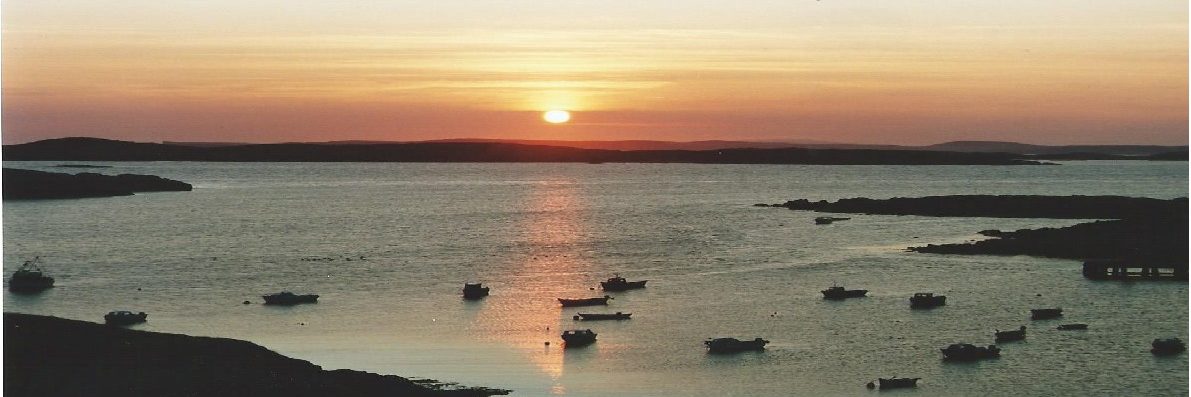
I grew up in Hamnavoe, Burra Isle on the west side of Shetland, the largest of a group of Islands offshore from the village of Scalloway, former capital of Shetland.

Home in my early years was with my father and mother and we lived with my grand- parents.  My grand- father was a retired fisherman and had a small croft with perhaps a dozen sheep. He along with several other crofters would also have sheep roaming the village which caused no end of problems especially when the human residents would find their gardens scavenged by hungry sheep. I can quite clearly recall quite a few oaths and threats issued to the crofters by irate house holders.

I found out later in life that it was the human residents that had invaded the sheep’s traditional pastures as the village of Hamnavoe was legally a common grazing (scattald as it was known locally) and still is to this day.

Hmanavoe Home

Hamnavoe Lighthouse

My father was a fisherman and then later a crofter, this I was to find out was very common throughout not only Burra but the whole of Shetland. Fishing was the main provider, however, as in times gone back fishing was a hard life and very much at the mercy of the weather even in summer months the sea around these remote Islands could turn in the blink of an eye. Most of the vessels when I was young were larger than the traditional open decked “sixareens”, six oars per boat, that fished the far “Haaf“ fishing grounds some decades before. I spent my young life close to the sea and would go off to the hand – line fishing with my grandfather I loved the sea and catching fish, however, I could never over- come my sea sickness and most often would come ashore cold wet and miserable. I was told later on in my life it was not uncommon for a fisherman to be sea sick his entire fishing life, unlike me there were no other job opportunities to be had. I only ventured off twice to the drift net herring fishing, with our family boat the Dauntless.  My second and last trip after being sea sick the entire night was to be told by an old crew member we were the only boat that caught no herring, ‘you’re a “ Jonah” go ashore and never come back’, I was very keen to take his advice.

Dad Dauntless

Dauntless hailing nets 1962

There was no other employment to be had, our croft as was common place in Shetland provided a small amount of lamb, salt mutton (reestit) and some eggs. In the North of Burra I can only remember one croft with a single cow. The extra income which helped keep our family alive came from the skilled hands of my mother and her knitting (by hand knitting and on the hand frame knitting machine). Our wool clip was sent off to Hunters of Brora in the North of Scotland and spun into yarn which was posted back. My grannie told of walking from the north of the Isle to the more fertile south of the Island to barter (trade) fish for wool.  She would then walk back home carrying the bag of wool which she posted off to the mill.

P.T.Robertson Staff

Selling the finished hosiery involved a boat and bus journey around about two hours to Shetland’s capital Lerwick.  I can clearly recall my first visit to Lerwick, at the age of five this was an experience never to be forgotten coming from such a tight knit community into the wide world. Mam had her brown paper parcel, inside her precious knitting which I was to see first-hand had being sold. Our first hosiery shop was H.C. Adams, 167 Commercial Street, the merchandise was inspected, word and money was exchanged but not all the knitwear went. Mam told me later on in life that often this was the case, it depended on the buyer. Our next and thankfully last shop was Tulloch of Shetland, 108-110 Commercial Street, where the final garments exchanged hands. Our next stop and one that stands out was to Sollotis sweet shop for my first ice cream.  Then across the street she took me for my first hair- cut by “Feeger” Tait another experience never forgotten. We walked to the north of the town and went into Irvine’s wool shop where she purchased knitting yarns and I first saw my first significant amount of greasy fleece spread out on the floor in the store at the back. We caught the bus home from Grantfield Stores directly opposite the wool shop, all in all an unforgettable experience!