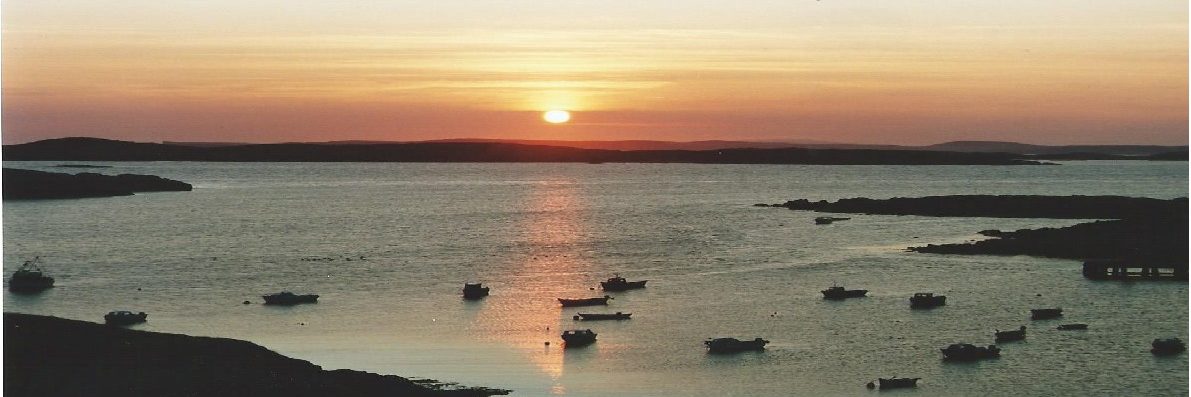
Farmers’ and Crofters’ Stories Told to Me Over the Years Part 2

In my time at the wool store I have listened to many tales from farmers and crofters skilled in the art of storytelling. I would often hear different versions of the same story, told in a particular way which would capture my attention. I will continue on with yarns’ being stories, from the south of the island, Bigton in particular; famous for its beautiful scenery and, for me personally it’s story tellers.

Village of Bigton with St. Ninian’s Isle to the Left
St. Ninian’s Isle

St Ninian’s Isle is one of the most famous islands in Shetland; namely for being connected by the UK largest tombolo, a narrow piece of sand known locally as an Ayre. Another claim to fame is that it was home to the St Ninan’s Isle Treasure hoard of Pictish objects dating back c750 – 825 AD. The treasure was discovered during excavations on the island in 1958 by a 15 year old Shetland schoolboy helping with the dig. He was part of a team excavating the ruins of a medieval church that once existed on the island. The treasure consisted of 28 pieces and was mostly silver, in a wooden box, buried under a stone slab marked with a cross.

Church Ruins and Tombolo
Inscriptions on Church Wall

We had a fair number of crofters in the Bigton area, quite a few of them were gifted storytellers, and I would always question them on the history of the area and the treasure trove in particular. The story that fascinated me the most was not of the treasure but of a particular crofter; no doubt the story has been embellished on over the years. As one would expect there was a fair amount of local interest in the treasure site with lots of speculation as to the find. It was said that one of the professors involved in the excavations was so fascinated by this particular crofter, his stature and size of his head as well as his teeth. If my memory is correct, he supposedly had a double row of lower teeth. The professor asked him to come to Edinburgh to conduct tests, as in his opinion the man closely resembled the Picts that had settled in Shetland around 300AD!

Clavil Croft, Bigton

St Ninan’s Isle is a very special place for Catherine and I; it is where I took Catherine on our first official date in May 1968. We visited the church site and walked along the steep cliffs at the West Side of the island, on our walk we came across a stout wooden post firmly anchored in the ground at the top of one of the steep cliffs. I asked the farmer who owned the Isle and as to the purpose of the post as there was no fence nearby. He had told me, “This was where a Bigton crofter would fasten his rope and climb down the cliffs to recover sea driven wreck wood.” The crofter was none other than the same person who had helped the padre down the cliffs in the fateful aircraft crash at Fitful in the 1940s. A practice he carried on until his late 70s. Cliff climbing was fairly common place at that time even in the 1960s, in Shetland many a piece of wreck wood would be utilised on the croft. 

Banks (Cliff Climbing) Rope
St. Ninian’s Isle South Gio

Stories of shipwrecks around this coastline were often told. One elderly crofter once told me he was travelling to his work early one morning from his home in Bigton when he saw a ship’s lifeboat drifting in past St Ninans Isle and heading toward the sandy ayre. He contacted a neighbour, who set off to retrieve the vessel, which he said had washed off the decks of a Russian merchant ship caught in a storm to the West of Shetland.

Another yarn by a Ness crofter was when they were off hand-line fishing to the West of the small uninhabited island of Colsay, their fishing lines would snag into what he said were two wrecked ships, possibly Dutch. I had asked how he knew this, and he’d said to me, “It was a story passed on through the generations, and the wrecks, called the Two Ships, was where the fish would gather around, and they always caught fish around the wrecks.” It was very important in times gone by before the advent of electronic fish finders that knowledge was passed on through the generations of successful fishing ground in order to feed their families.

Colsay Isle
Inside Colsay

In and About Lerwick Harbour – Leisure and Aquatic Wild Life

I have mentioned sailing and rowing in a previous blog, however there are other leisure activities which take place in and about the harbour. One of my favourite pastimes is to walk up the Staney Hill behind our house and observe the harbour traffic, as well as the sunrise over Bressay.

Sunrise Over Bressay Watchtower

When I went to school in Lerwick in 1961, if you wished to go swimming in Lerwick you would have to take to the sea; the most used place was the Wari Gio, located at the Knab. Situated at the foot of the cliffs at the Knab, and in open water with little in the way of shelter, swimming was restricted to short summer months, when the weather was favourable; even then the sea was very cold — as I found out when I was younger on the beautiful sandy beaches of my childhood home of Burra Isle! The other two favourite swimming locations were the Dinghy and Grottie Buckie sandy beaches at Sound in Lerwick, again open water. Nowadays there are a few open water swimmers who take to the sea in the harbour; I notice they mostly wear wet suits! 

Open Water Swimmers with Swim Boards, Lerwick Harbour

Jet Skis were quite a favourable pastime in past years however they appear less frequent nowadays.

Jet Ski

I noticed an unusual sight while walking along the sea shore at the Sletts; although not on the water, just quite close to the cliff edge, a scrambler was testing out his manoeuvres. As you may know, motorbikes are very popular here, so perhaps this is unsurprising. Scramblers are often seen at the Sands of Sound too.

Motorbike Scrambling

By far the most popular maritime activity is observing the local aquatic wild life which visits the harbour. In recent summers there has been a huge interest in boat trips to visit the sea bird colonies of the cliffs of Noss, a small island close to the southernmost entrance of Lerwick harbour. 

Noss Boat and Sea Birds

On route to the cliffs it is quite common to see plenty of seals and often a dolphin will make an appearance. Otters are becoming more common however when I spot them on my harbour walks I usually have left my camera home! If you are really lucky you may spot one of the Orca pods, which enjoy hunting the local seal colonies. Just recently at the mouth of the harbour Catherine and I observed a pair of Humpback Whales they appeared to be busy feeding. It was truly spectacular.

Seals at Sound
Orca at Lerwick North Harbour
Humpback Whale
Bearded Seal at Lerwick Pier

In an earlier blog I mentioned the Eastern European Klondike fleet, which were a fixture mainly in the 1980s. Unfortunately one or two foundered at the harbour limits and in the summer months I have observed divers visiting these wrecks. Our crystal clear, unpolluted waters are perfect for visiting dive teams.

Lunahods Wreck on Bressay
Divers at the Wreck

Farmers’ and Crofters’ Stories Told to Me Over the Years

Over my 50 plus years at the wool store, work was very physical and at times quite demanding, however the early years were most the interesting and enjoyable. I explained in the first of my blogs that the wool producers were paid on the day. I would spend quite some time working out the various prices of a crofters clip and, at first, this was done by a ready reckoner. The producer was always present at this transaction and often it was the case they would share with me their stories of life in general and of times gone by.

I would like to share with you some of these stories and to avoid any offence I will not mention any names; I will post images of the area or district told in the story.

I will start at the South End of Shetland, Fitful Head in particular; it is a lofty headland which overlooks Sumburgh Airport and has a strong connection with my fore bearers. At a very early age I first came to know the area from my grandmother, who told me that this was where some of my ancestors came from; a place called the Garths Banks. It’s an area of rough ground close to the seashore and lying beneath  Fitful Head, supposedly the first port of call for my 5x-great grandparent Saunders Tuff, as he was known in Shetland. His proper name was Alexander Tough. He was born at Fintry in Aberdeenshire on 19th February 1775. A soldier of the 92nd Highland Regiment, referred to as an Army Orderly and also a batman he served all through the French War, and fought at the Battle of Corunna (which was a battle of the peninsular war in 1809). Saunders was reputedly part of the bodyguard of the commander of the British forces Sir John Moore. Saunders was wounded in the battle and was awarded a medal for bravery under attack. While carrying out his duties for a Sir William Wood, sometimes referred to as Captain Wood, he met Margaret Wood, William’s only daughter. The favourite part of the story told to me by my grandmother, was of Saunders and the daughter Margaret running away together, escaping from a castle and making their getaway on the back of a white horse only to end up on a boat. This was a very vivid scene set in the mind of a young boy living in a small island, I suppose my imagination ran riot. I could envisage them landing at Grutness, most southerly harbour in the islands, and setting off north. It is recorded that they became acquainted with one of the late Grierson’s of Quendale, landlords, and were invited to stay and settled in a croft known as “Refuge”, at the head of a windswept valley sweeping down from Fitful Head. The township was behind the Garth Banks and rested on the cliff edge below the heights of Fitful Head. Saunders and Margaret Wood would appear to be the first crofters in our family lineage! They had three daughters, two married men from district; the other married a John Henderson from Setter, Burra Isle; our side of the family.

Catherine Climbing Fitful Head
Close to the Cliff Edge at Fitful Head
Croft House Remains at Fitful Head (Refuge?)

 Fitful Head was reputedly the home of a Shetland folklore legend named Black Eric, a hermit who lived in a cave deep in the cliffs; he was renowned for his sheep thieving. This was fairly common in Shetland in times gone by, there are several areas in Shetland with stories of the local sheep “tief”, I recall my dad telling me this story when we were passing by Fitful Head in the family fishing boat, named the Dauntless, travelling from Burra to Lerwick for the summer herring fishing. 

Fitful Head Cliffs
Sheep in the Banks at Fitful Head
Cave in the Cliffs

The next story is also war related; the Second World War specifically, and a story told to me by an elderly farmer from the south mainland. Fitful Head once again is the setting of the story and the tragic event took place in March 1942. The aircraft was a Halifax bomber returning from a failed attempt to sink the German battleship ‘Tirpitz’ at anchor in a Norwegian Fjord. “It was unable to land at Sumburgh Airport,” the farmer had told me, it was circling the airport at night but could not land as the airstrip was under a lights out curfew the plane crashed into the cliffs on the west side of the headland. The first knowledge of the incident was by three farmers gathering their sheep on the slopes of the cliff. The farmer telling me the story said they’d come around a bend in the cliffs and came across two airmen; it was if they were sitting resting on the grassy slope, but both were deceased. A search of the area unearthed wreckage further down the cliffs at the steep rocky foreshore, the location of the crash site made it impossible to land by sea. They sent for a local man who was renowned for his climbing abilities, he ventured down the cliff and discovered the remains of a third crew member. It was impossible to recover the body, which was buried on the rocky cliff face. A padre from nearby Sumburgh airfield was lowered down by ropes with the help of the local climber and prayers were said over the body.

Sumburgh Airport on the Left
Possible Crash Site

Later on at the wool store I was very fortunate to work with the daughter of the farmer who had told me the story; she confirmed what her dad had told me. I believe the relatives of the ill-fated crew wrote to the farmer in question and his family were involved, along with people of the district, in erecting a memorial stone tablet which was placed at the top of the cliff. I have not seen the memorial; however one of the crofters who were putting the stone in place described to me the difficulties in erecting the memorial at the cliff top, it proved to be a hazardous operation.

Fitful from Ireland, Bigton

In and About Lerwick Harbour – Cargo, Ferries and Cruise Liners

Living and working at the old North Road close to the sea has many advantages; for instance, a load of wool ready for shipping and leaving us is less than five minutes away from the cargo boat. We are also very fortunate in that over the back fence we are virtually in the country due to the Staney Hill. To quote one well-known local the hills are the “lungs” of Lerwick. The only downside to being so close to the quay side is that we are subject to maritime noise sometimes on the night, discharging cargo boats and on board generators supplying power to the vessels.

Looking South Over Lerwick

Cargo vessels are the lifeline for the Shetland Islands, bringing in essential supplies and transporting goods and livestock to the global market place. In the winter months we are at the mercy of the inclement weather and occasionally there can be a shortage of foodstuffs leading to a slight panic in some cases, people bulk buying just in case.

Streamline Cargo Boat Loading
Helliar Cargo Vessel

As I have mentioned before, we overlook the ferry terminal and on a fine morning can hear the announcement, “Car drivers and their passengers should proceed to the car decks.” Across the harbour is the island of Bressay which is served by a small roll-on roll-off ferry, it beggars belief why in these modern times and with the island’s oil wealth there is not a fixed link, similar to our neighbours the Faroe Islands and Orkney.

Northlink Ferry and Cargo Ship
Bressay Ferry Crossing
Old Ferry St. Clair

In the summer months, Lerwick Harbour is home to dozens of cruise liners brining over 50,000 people from all over the globe to our remote archipelago. As many as three cruise ships in one day can visit; two of the berths used are directly below our home and my work. These visitors provide much needed revenue to the islands; the streets of Lerwick are inundated with crowds of people. Bus trips take them to all parts of Shetland where they witness the beauty of our islands and visit our historic places of interest.

A Liner at Night Berthed Below the Wool Store
Cruise Liner at Anchor

Roadside Beanie – The Beginning

It has been quite an unforgettable journey; my tenure as patron of Shetland Wool Week 2019. At first I was overawed by the enormity of my task! Design a beanie and attend Edinburgh Yarn Festival.  Writing these blogs and delving into my archives and photographs gave me a focus, and also brought back memories of my journey; most of them positive. One of my most vivid experiences of Wool Week was standing at the front door of my childhood home at Roadside, Hamnavoe, Burra Isle. I found myself thinking how on earth I got here; standing holding a Burra Bear called Peerie Olie o’ Roadside! As I stood there with the sea breaking in the background at the Hamnavoe Lighthouse, I recalled my early years living with my grandparents, until our family home was built further up the village. Most of my time was spent with my grandad, a retired fisherman, spending most of the time on his croft and in his Shetland model boat, the Betsie. Fishing was still very much part of his life and in the summer months we would spend a lot of time off in his boat catching all kinds of fish. He took fishing quite serious as it was still important to put food on the table. I would often take part in these fishing trips which could be for hours at a time. Often cold or sea sick, rather than go ashore he would put me ashore on one of the outer isles, and return when he had caught sufficient fish. There was no going easy on me and returning home early! I remember on more than one occasion sheltering behind a rock, cold and recovering from sea sickness.

Bairns in the Betsie
Hamnavoe Lighthouse

My father told me that my grandfather had suffered with sea sickness all of his life, however he had little choice other than to continue as a fisherman as he had a family to support and there were no other job opportunities. I continued to join him on his fishing trips despite my poor constitution however looking back I wonder if he was trying to discourage me from a life at sea.

Fishing at the Stiggies
Dad Cleaning Fish

 Many years later when clearing out an office in the wool store, a Shetland magazine fell on the floor open at a page, the headlines read, “The Burra Isle Boat Disaster”. It told the tragic story of what happened on the Monday morning of 16th September, 1907, when seven Burra Isle fishermen set out to sail from Hamnavoe to Scalloway, then travel overland to join their boats which were on the East side of Shetland for the summer herring fishing. The unfortunate men were crammed together in a small sail boat in fairly rough weather when they were hit by a fierce squall from the west, while crossing an exposed stretch of water called the Firths, a funnel of sea between Burra Isle and the smaller isles Oxna and Papa. Sea swell and breakers can roll in from the Atlantic Ocean; with the next landfall being America. The boat capsized and the men went into the water and four of them tried to swim for shore at the point of Brunaness a headland on Burra Isle, despite being strong swimmers they all perished. The three remaining men clung to the capsized boat and were rescued by James Laurenson SNR; skipper of the Qui Vive with his crew, his son James (15), my grandfather and two other fishermen. They landed the rescued men in Scalloway where they were tended to by a doctor.

Burra Sail Boats of that Era (c. James Henry)
Burra Sail Boat

A terrible tragic disaster to witness at any age, but at the tender age of 15 must have left an indelible mark on one’s life. Witnessing such an event once in your lifetime but to have to witness such harrowing times again would have been hard to bear.

Again the woolstore played a part in me discovering another serious event my grandfather had to witness. Along with my old boss we were sorting wool one winter’s night in the early 1980s; as usual he would have on Radio Scotland. It was by chance I heard the broadcast; a tale of two trawlers, the Eleanor Viking who foundered on the notorious Ve Skerries, a mile long reef of the northwest coast of Shetland in 1978. The crew of 8 fishermen were plucked from the rocks by a heroic helicopter crew. The other incident, in 1931, involved the trawler Ben Doran who had hit the reef in foul weather; sadly there were no helicopters at that time and the crew of 8 all perished. A rescue was attempted by the Burra Isle fishing boat the Smiler Morn but the weather was too severe. I heard from that broadcast a member of the crew who again witnessed this harrowing scene was my grandfather, James Laurenson!

Fishing Boat of that Era (c. James Henry)
Small Sailboat
Skerries

Growing up in a tightly knit island community I had never been told of any fishing disasters, they were never mentioned. Our house was situated on a slight hill overlooking the Firths, my only lasting memory of this stretch of water was as a child kicking a leather football and on one occasion it gathered speed down the hill and over the cliff into the sea. I had to report this to my mother and I feared her reaction as money was scarce for such luxuries, in the 1950s. I was taken completely by surprise when she informed that she had been listening to the trawler band on the radio, when she was given a message. It was from Robbie o’ Clate, the skipper of the fishing boat the Northern Light he had picked up my football on the Firths and I was to come down to the pier and pick it up. I was given money to buy the skipper a packet of 10 cigarettes for his reward.

Firths on a Bad Day

I hold the utmost regard for all fishermen and a great respect for the sea; I firmly believe that the experiences my grandfather had to witness had a great bearing on how I ended up as a patron of Shetland Wool Week!

Me and the Bairns’ Beanies

In and About Lerwick Harbour, 2000s

In a previous blog I mentioned how fortunate I was to work and live quite close to the sea overlooking Lerwick Harbour. I concentrated on the Klondike era of the 1980s and late 90s. I would now like to share with you some more of my experiences and images from in and around the harbour. The port of Lerwick and its harbour is the maritime crossroads of the North Sea, and is sheltered by the island of Bressay to the East and has two entrances; the “North Mooth” and the “Sooth Mooth”. It is a modern harbour and caters for all types of seagoing: craft, pleasure, fishing, cargo, ferries, cruise ships, oil and gas as well as decommissioning. It not only provides shelter for seafarers but also aquatic wildlife and sea birds. Our home is situated a short distance from the sea in the town of Lerwick, however we are also very fortunate in that, at the rear of our property, we have the Staney Hill which overlooks the town and  is an ideal spot to view harbour traffic. We are also very keen dog walkers and have spent many happy hours walking the shore around the harbour. 

Overlooking the North Mooth at Lerwick Harbour
Harbour Sooth Mooth

I will split my blogs on the harbour into various topics of maritime life, beginning with pleasure craft activities which take place mainly in the summer months when the weather is more favourable.

Sailing used to be a way of life in Shetland when fishermen would set off for the far fishing grounds under sail. Nowadays, these boats are used mainly for pleasure. When I was a child we used to look forward to the regatta and all the visiting crews coming to the isle, it was a great community social event.

Dinghy Race
Dinghy Sailing

In times gone by fishermen used to row off to their larger vessels in wooden Shetland model boats known locally as “Yoals”. There are now mostly used to race in annual rowing regattas, most districts have their own yoal which is crewed by members of the community, male and female, young and old.

Yoals
Yoal Racing at Lerwick Harbour

The Bergen to Shetland Races involve ocean going yachts that compete in the annual event, leaving from the port of Bergen in Western Norway to Lerwick harbour. It started in the 1980s and now is a major competitive sailing event, attracting many international entries. 

Bergen Race
Bergen Race Competitiors

Shetland also acted as a host to The Tall Ships Race most recently in 2011; involving mainly larger sailing vessels and to encourage training and international friendship for young people in the art of sailing.

Tall Ships at Berth in Lerwick, 2011
Tall Ships Leaving

Visiting the Shetland Sheep Society in Nuneaton, 2018

It was in the late 1970s when I first became aware of a serious interest in Shetland sheep from outside the isles. I had heard from local crofters that some Shetland sheep had been shipped to the U.S.; I knew two crofters quite well who had been involved in this project, and if my memory is correct their breeding stock were shipped to a U.S Colonel.

Shetland Rams

Over the years I came into contact with Shetland sheep breeders from the mainland who visited our wool store. I became good friends with some of them and through listening to them realised they had a passion and commitment to the humble Shetland sheep. Most of these people were small time flock owners, selectively breeding for extra fine wool quality, unlike Shetland crofters who depended on the sheep as a livelihood. I became close friends with one individual from England; his father had been a member of the original Shetland Flock Book committee tasked with setting the Shetland sheep breed standards in 1927.

I heard, from him, how the Shetland Sheep Breeders Group was formed in 1985 to help breeders outside Shetland maintain flocks conforming to the 1927 breed standard. He invited me on more than one occasion to come down to the mainland and see the work carried out by the group, helping preserve and promote Shetland sheep. Sadly, I never took him up on his offer all those years ago. 

When the group next invited me down to England to talk to them, I agreed to travel as long as my ‘minder’ Catherine travelled with me! On Friday 16th November 2018, Catherine and I set off from Shetland to Birmingham; I had at long last agreed to give a powerpoint presentation on my working life with Shetland wool, sheep and crofters. On the Friday night we were invited to have a meal with some old acquaintances and met with several other group members.

On Saturday morning Catherine had organised with David and Lynne White owners of the Ashby Shetland sheep flock to see first- hand their animals. On route we visited David & Lynne White’s home to pick up ewe’s food. While we were getting ready I looked out their front room window and to my surprise at the foot the hill leading down from the house saw what looked like rows of parked boats! “What on earth are they doing here so far inland?” I asked. David explained that it was the Braunston Canal and the narrow boats were hired out in the summer tourist season. The canals used to be an important part of moving goods throughout the country.

David & Lynne’s

When we arrived at the Ashby flock my first sighting was of a group of Shetland Katmogit sheep, my first reaction was how small they were and they resembled sheep I had seen beside the late “Benjie” Hunter back home in Nesting. I was able to handle some of the sheep and what really took my eye was the fibre fineness of the wool. Not only was that, but also very surprisingly the handle (softness) was very good despite the sheep grazing on very rich pasture. I was always led to believe that if you take a Shetland sheep off the native hill and put it on green grass it would alter the handle of the wool, making it bulk up a bit. This was certainly not the case with these sheep, and the subsequent moorit and black sheep I examined. Overall, I was very surprised with high standard of the flock and the husbandry used in managing the sheep. What I had witnessed dispelled any doubts I had about how Shetland sheep were being bred outwith our islands. It was a shame I had left it so late to see what my old friend had told me on his visits to the wool store. Still better late than never!

Ashby Katmogit Ewe Rams
Oliver with Some of the Ashby Flock
Catherine with Some of the Ewes

On the way back to our hotel, David said he would take us on a scenic route through the village of Braunston and he explained this was a very historic part of England. As we had some time to spare he took us to what, in my opinion was besides the sheep, the highlight of our short holiday. We parked up in the drive of the Ashby St Ledger church; a beautiful building and one of the most intriguing and historic in England. Entering the church it was if I had gone back in time, the décor and layout had changed little since its construction in the 14th century, parts of the site dated as far back as the 12th century. We were most fortunate to have a local guide in David who informed us of the interior of the church and the various areas where the nobility were kept apart from the more humble parishioners.

Ashby St. Ledger’s Church
Inside the Church

At the rear of the church stood a very regal imposing mansion that was the Manor House of Ashby St Ledgers. From 1375 to 1611 it was the home of the Catesby family. In 1605 Robert Catesby and his fellow conspirators including Guy Fawkes plotted to assassinate King James 1st by blowing up the Houses of Parliament in a notorious act of treason. What a great privilege to actually be at the site of such a significant part of England’s history, especially one which played such an important role in my growing up and building all those bonfires throughout my childhood!

Manor House

Travelling back through the village and still recovering from our historic visit, David informed us that 2 of their young Moorit rams had escaped from a field next to the church yard. He would have to round them up; he disappeared into the neighbouring field and after a few minutes out from the grave yard came the missing rams and David. So, I had witnessed my first “caaing” of Shetland sheep in England! 

To round off a very eventful trip David took us to a huge shopping complex on the outskirts of Rugby. Catherine could not believe her good fortune and did quite a bit of shopping! We were both overpowered by our day and could not be more grateful to our host David for his hospitality and kindness, showing us their flock, taking Catherine shopping and our journey into one of the most historic events of our country.

On the Sunday morning, as part of the Shetland Sheep Society’s conference, I presented my power point and my life with Shetland wool; including some of my crofting stories and answered quite a few questions. There was also some fleece on display and, again, I was impressed by the quality of the wool. When asked to judge the fleece I found it extremely difficult. I discovered there were around 30 judges, inspectors, and trainees present from all over the UK and saw the level of commitment the group has to their Shetland Sheep.

My Shetland Sheep Society Talk

This was definitely one of the most memorable events in my working life, I had presented powerpoints and talks at various universities and textile gatherings, whilst quite interesting and challenging they could not hold a candle (pardon the pun) to our visit to the heart of England!

My 2019 Shetland Wool Week Experience Part 7

In an earlier blog on my Wool Week experiences I briefly mentioned both the charity auction project and the competitions; I will now add a little more detail. The winners of the two competitions were announced and presented with their prizes at the opening ceremony of Shetland Wool Week.

Seasons of the Shetland Crofter follows on from the highly successful Real Shetland Yarns book of 2012 where people were asked to share their individual stories and images involving Shetland textiles, crofting and farming. The main sponsors, Vispring presented the winning entry with a handmade luxury bed. Earlier this year people were asked to send in their pictures and short stories representing the four seasons in Shetland crofting and farming. The images and stories highlight the changing seasons by camera and words of life on the croft and farm in Shetland. We have even had four seasons in one day as I write this! I walked our granddaughter’s dog in bright sunshine, went over the hill and struggled against 50 mile an hour winds, a short time later encountered heavy hail showers. There were many entries in the 4 categories, spring, summer, autumn & winter. The overall winner received a Vispring bed valued at £5,000, also a 2 night stay in the Sumburgh Head complex, donated by joint sponsors Shetland Amenity trust, and a Seasons of the Shetland Crofter book.

Chris from Vispring Announcing Winners of Vispring Competition
Vispring Prize – A Handmade Luxury Bed

1st place category winners in the four seasons received £100 of J&S vouchers, a Vispring branded J&S R.S.W. Throw and a copy of the book. 23 shortlisted entries received a throw as above, a copy of the book and a pair of Real Shetland wool J&S worsted socks.

The Seasons of The Crofter Book is available to buy from Jamieson & Smith for those who are interested!

Seasons of the Shetland Crofter Book

Jamieson of Shetland also had a competition for people to enter participants were asked to contribute their favourite stories & images from their experience of visiting their company in the 10 years of Wool Week. There were quite a few entries and the winning images and stories were displayed in Jamieson’s shop window, they also received in store vouchers.

Jamiesons’ Window Display
Garry Jamieson Announcing Winners of Jamieson Competition

The Shetland Wool Week Scarf project was the work of Faye Hackers of the Shetland textile college. The project involved people from the Shetland Textile Industry; I was delighted to take part in this as Wool Week patron. Faye collated their various comments about what they liked about Shetland. This was then taken by Faye and designed into one – off scarves which were auctioned off for charity at Shetland Wool Week. In total the auction raised £1,776.00 which was split amongst charities which were chosen by the individuals involved in the project. Cancer Research, Shetland MRI Scanner, Mind Your Head, Global Yell, Lerwick Brass Band and the Whalsay Heritage Centre.

Charity Patron Museum Scarf Display
My Piece in the Auction

All the yarns used in the project were donated free by Jamieson & Smith, a continuation of involvement with the Textile College since its conception over 20 years ago. We consider it vitally important that we continue to sponsor and encourage our young textile students which are the lifeblood of our future textile community. I am very pleased to say I have been involved in all these sponsorships since the opening of the college all those years ago.

I will post a blog on our work with the college at a later date.

My 2019 Shetland Wool Week Experience Part 6

We had very little time to rest before traveling out of Lerwick to Tingwall and the local village hall, for one of the last events of Wool Week 2019 and, for me, the most important event. We would not have had a Shetland Wool Week had it not been for the Flock book society, keepers of the ancient breed of Shetland sheep which is famous for its fine wool. It was obvious to me when tasked to create a Wool Week in our islands; who better equipped to help us but this group of custodians who are dedicated to the purity of the breed. After, all the event is called Shetland Wool Week and for me there is only one true meaning and that is Real Shetland wool from native Shetland sheep.

Sponsors

IMAGE SPONSORS

It was the Shetland Flock Book 2019 & Fine Fleece Prize-giving Supper and Dance with sponsors Vispring. I was to present the trophies to the winners of the annual Flock Book show, fine wool competition as the sponsors of the event Vispring had returned back home. The evening was a social evening with traditional Shetland fiddle and accordion music, Shetland dancing and a light supper featuring local fare.

Tingwall Hall

Catherine and I were joined at our table by two ladies from Germany, one lady from Switzerland and a husband and wife from Yorkshire in England. The dancing started the evening was filled with excellent Shetland music; there were not many people on the dance floor so Catherine and I took to the floor. Also dancing were members of the Lerwick dance club and one in particular stood out one of our crofters and my old friend, Allison “Flea” Duncan, I had always wondered how he came by the nickname, just watching the speed of his feet, made me think that could be a reason for his title. He is always “buzzing” around at a rate of knots, which is also the more likely explanation. However, it was very appropriate to have local dancers showing the visitors Shetland dancing. As the dancing progressed I asked several of the visitors to take part and I was surprised how well they could pick up the dance steps.

Dancing

There was a break for supper and refreshments; it was supposed to be a light supper, however the food on offer mostly local fare was very plentiful and of a very high standard. The Shetland Flock Book laid on a very impressive spread of food and it was most appreciated by the visitors.

Salt Cod and Oatcakes
Shetland Lamb Samosa Cups

Next was the prize-giving and in my role as patron I was to carry out the task of presenting the prizes for the Wool on the hoof; judging the quality of wool on the live animals. The winners of the Fine Fleece Competition were also to be presented with prizes, the prize winners all received trophies and cash prizes from the main sponsors Vispring.

AQR Cross Vispring Fleece Champion
Eric Graham, Vispring Wool on the Hoof Champion

Following the prize-giving it was back to the dancefloor and at this stage I was starting to wilt, and as if to waken me up I would get the occasional slap on the back from the ever present “Flea”. After the last dance we said our farewells to our companions, thanking them for their company and wished them a safe journey home.

On Sunday afternoon we travelled north to Brae, and met up with my son Adrian, his wife Sarah, her parents Frank and Morag, and of course our two granddaughters Erin and Elise. We first went to the local community centre where there were stalls of local crafts goods on show and for sale. The Brae Up Helly Aa shed was open to visitors who found out all about the fire festival. In the Brae Hall were teas, exhibitions and demonstrations by the Shetland Guild of Spinners Weavers Dyers and Knitters. Entertainment was provided by the Northmavine Fiddle and Accordion group who virtually played non-stop. The food was of a very high standard and one of the organisers said they actually had to send for more supplies! The event came to an end with the draw of the raffle prizes where, once again, I was given the task of drawing out the winning tickets. If my memory is correct, the raffle was over £500.00 and the proceeds were given to the Peerie Makkers, a very generous donation to a very worthy cause; the future of our hand knitting.

Brae Crowd
Raffle

We walked across the road to our son’s house and on the way met one of the older neighbours, who had commented that he’d never seen so many cars in Brae before they were parked on both sides of the main road. Surely a very fitting end to a successful and wonderful Shetland Wool Week!

My 2019 Shetland Wool Week Experience Part 5

 On Saturday morning our first stop was the hub at the Shetland Museum where we chatted to some more of the visitors. We spent a bit more time at the various exhibitions, one display of work in particular stood out for me. The work in question was titled The Lairds Witch by Fine Arts student Susan Pearson from the island of Whalsay, and she was awarded the Shetland Wool Week exhibition prize to highlight her work in knit and concrete sculptures. While I was in the boat hall I was asked a non-wool related question by the husband of one of the ladies taking part in wool week. He said he was a small boat builder back home in his native Finland and was particularly interested in the sixareen vessel on display in the boat hall. He enquired as to where the wood would have come from to build the sixareen in the late 1800s, as there were no trees in Shetland. Where he lived he simply went out into the forest and cut down a tree in order to build a boat. I replied, “Our wood nowadays is imported into Shetland, I suppose the same applied over 100 years ago. It was also possible that Shetland boat builders would salvage wreck wood from the sea, which had been lost overboard whilst being transported from country to country”. When I was a child back home in Burra Isle I could remember a lot of timber coming ashore lost from ships when the deck cargo shifted. I took him through to the boat shed where older boats are restored, he was really interested in this and I left him to wander around the various boats. I have to say it was nice to talk about another subject other than wool!

Sixareen
The Lairds Witch

We left the Museum and travelled to the Makkers Market in the new Anderson High School, where all types of local textile products were on show and for sale. The stands were doing brisk business as both halls were packed with people.

Makkers’ Market at AHS
Makkers’ Market

We ventured upstairs and joined in with the “Peerie Makkers”; that is younger school children who are instructed in the art of hand knitting by volunteers, usually in their break times while at school. I was invited to sit with some of the youngsters while they were knitting; one young girl asked could I knit. I replied, “When I was perhaps 10 years old we were taught to knit in our break time by the school cleaner. I had not really knitted much in over 60 years”, she promptly said “you can have a go with this knitting “, and gave me a partially finished lace knitting piece on two knitting needles. I was aware of several pairs of young eyes watching me, I replied, “This is lace knitting it is far too fine for me to knit as I do not have my glasses”. This was met with a lot of smiling faces and with that I wished them all the best with their knitting and left.

The Peerie Makkers and I

My next trip was to my old island home of Burra and in particular to the iconic Burra Bears workshop where we met with owner Wendy Inkster. Wendy and I chatted about how busy she had been with Wool Week; she then took me completely by surprise and presented me with a most splendid Burra Bear. My first reaction was of total surprise and also appreciation with such a generous gift, I also felt very nostalgic as the Bear, Peerie Olie o’ Roadside, named by Wendy, had been made from a Fair Isle all over jumper my late mother had knitted for me over 50 years ago. Several years ago we had asked Wendy to make 3 bears for our grandchildren, I was unaware there was any material left over. I said to Catherine before we leave the isle I wish to go back to my childhood home of Roadside in Hamnavoe and have a picture taken with Peerie Olie o Roadside in front of my grannie’s house. It was as if young Olie had gone full circle! As I stood before the door I noticed the rusting remains of the ornate garden railing which I used to stand and hold on to. I am a very sentimental individual and must admit I had one of those heart felt moments. Even more so as I was standing at the Roadside house who should drive up and stop, my sister Alexis, quite a coincidence or what!

Wendy and I
Two Ollies at Roadside

We then proceeded to travel down to the village of Sandwick in the south of Shetland and to the Hoswick visitor centre, where various classes had been held all through week. We had a nice cup of tea and a scone and wandered amongst all the old textile pieces on display. We then went a short distance along the road and paid a visit to designer Niela Nell Keria in her studio and had the unexpected pleasure to meet and old friend Mary-Jane Mucklestone, from the USA, who often visits us with textile tour groups. We had a chat with each other and then set off for home, now running out of time before my next assignment at night which I shall deal with in my next blog.

Hoswick Centre
Neila, Mary-Jane and I