We had lost our marketing person at work in the summer of 2010 at fairly short notice and just before she left she had signed us up for a visit and lectures at Knit Camp, an international textile event at Stirling University in September. Sandra Manson, also of J&S, and I agreed to deputise at the event, along with my wife Catherine, who would also help.
Catherine and I travelled down via Scrabster in the north of Scotland and stopped off at Brora for a nostalgic visit to one of my old friends from Hunter of Brora, spinning manager Bill Ballantyne. We travelled down to Stirling through some of the most breathtaking scenery in the world, the Highlands of Scotland, and stayed overnight at the Kinlochard Hotel.
Brora
We walked part of the West Highland Way and along the shores of the loch amidst beautiful scenery. Much to my surprise we came across a field of Shetland coloured sheep! They looked very similar to the native Shetland coloured sheep belonging to the Abernethy family back home in Shetland. Suddenly the penny dropped, of course Fergus Wood, former chief executive of the Scottish Fine Wool Project in which I took part as a wool judge.
We found our way to a group of houses and enquired the householder, “Was this the home of Fergus Wood?” He pointed out a large building called Kinlochard House and added, “Fergus was not at home, and did we know he was Provost of Stirling!”
Walking the West Highland WayLoch Lomand
We travelled into Stirling the next day and met Sandra at the university to set up our stand. This was the start of an extremely busy week, I gave a talk on Shetland, sheep, wool and textiles and deputised on our stand for Sandra. She agreed to take part in a spur of the moment event, back to back challenge to make a garment straight from the sheep to completing the finished garment. First of all they had to find a team of hand spinners and knitters and, of course, a suitable fleece. This did not present a problem attending the event was none other than Fergus Wood, Provost of Stirling, who brought along some of his wool clip, out of which I chose a suitable fleece.
Provost Fergus Wood at Our Stand
The team of knitters and spinners, who came from all over the world only met that day yet managed to produce the finished garment in approximately six hours a very admirable result indeed from a talented group of strangers.
Back to Back Challenge
Not only did I meet my old Friend Fergus Wood, I also met up with quite a few designers; some new to me and some were old friends, such as Nancy Bush from the U.S. who specialised in fine lace as a designer, author and knitter. The highlight of my visit was to spend time with one of the first designers to use our knitting yarns in 1969, Sasha Kagan. I also met up with fine lace knitter and designer Liz Loveick from Orkney; we put on a joint workshop and talk to some of the visitors. I was honoured to meet up with one of the younger upcoming designers Jared Flood of Brooklyn Tweed.
Sandra on Our Stand at Knit Camp
Quite a successful and enjoyable trip: very hard work, I now had to come back down to earth and return to the wool store!
I received a very surprising and pleasant birthday gift from Catherine for my 60th birthday – a holiday to Norway; the closest landmass to us across the North Sea to the east. We travelled by plane from Sumburgh to Bergen, our first glimpse of Norway from the plane was a panorama below us of small islands and, unlike back home, a lot were connected by bridges. We travelled into the city of Bergen and stayed in a hotel very close to the sea, so we felt quite at home. The harbour front was a hive of activity, surprisingly not with fishing vessels, but mostly pleasure craft of all sizes, charter tour boats and the occasional oil related vessel.
Bergen Harbour TrafficOliver in Bergen
All along the waterfront there were beautiful wooden buildings and at the rear of them on the tree-clad hillside were private houses seemingly perched on a very steep slope which rose to quite a considerable height. The city was overlooked by mountains, one in particular I was to get up close and personal with. As a child I had no fear of heights (climbing the cliffs back home was no problem), but I was reluctant; Catherine wished to explore the mountain despite this anyway! She assured me would travel to the top of the mountain Floyen by the Funicular railway, even if it was an almost vertical climb! This was a very eventful journey for me and, despite the stunning views, I was ill at ease, already concerned about the return journey.
Bergen From FloyenBergen Waterfront
When we reached the summit (much to my relief), the view was amazing, we began exploring and eventually escaped the crowds of people and entered a forest walk surrounded by huge fir trees. The further we travelled the more rugged the land became; we passed by lochs and came upon a clearing where we encountered our first Norwegian sheep, quite tame, and a red squirrel. Catherine did not want to stop and chose a darker, shadier path through the trees and I knew it, we came across our first Troll. I had always envisaged supernatural beings frequenting these mountain ranges, but I need not have worried as this one was made of wood.
Catherine Meets a Troll
We came to a sign saying the way down and the distance in kilometres, however Catherine as usual said, “No, we would travel back down the way we came up!” There was no point in arguing, I found myself standing up in the front of the train trapped behind a barrier with no escape, watching the vertical descent. It did not help, standing alongside me Catherine saying, “Open your eyes you are missing the view!”
The next trip was one I had actually planned, a day trip to visit a friend of mine I had met in Shetland on a visit to the wool store Gunnar Mhyr. His family owned a wool mill which his grandfather had built in 1898 called Hillesvag Ullvarefabrikk. It was situated on the shore of Osterfjord and was one of only a handful of mills left in Norway. We travelled by bus to Knarvik where Gunnar picked us up and took us to Hillesvag, and their mill. We met with the Mhyr family and were shown around the mill by Gunnar who told us of the history of the mill. In the beginning there was no road in, all traffic came by sea, and the farmers would row to the mill with their wool clip. If my memory is correct the mill at one time was powered by Hydropower. This refers to the conversion of energy from flowing water, and there was certainly plenty of that cascading down the mountains. This was a very special day for us and we really appreciated the hospitality and kindness shown to us by Gunnar and his family.
Hillesvag MillGunnar, His Wife and Catherine
Our next outing was again very memorable, titled Norway in a Nutshell, here we witnessed some of the most stunning scenery we had ever seen; mountains, valleys, fjords and the highlight being a stop at a gigantic waterfall. We followed our travel companions out on to a damp platform viewing point, and out of the mist on the side of the waterfall you could make out the ruins of a croft house similar to ones back home. I was turning away when I heard a mournful wailing sound coming from the direction of the croft house. Suddenly an image appeared for several seconds, a beautiful long haired blond woman, and as she disappeared I saw what looked like a long animal like tail. A loud gasp came from the watchers as another one appeared. As usual I was to slow with my camera, and as Catherine always says “typical, missed it again”! We continued our journey onward to Flam and arrived at the head of fjord where on we boarded a ship and travelled down the fjord to Gudvagen and then by bus and finally a train to Bergen. I simply had to know about the person at the waterfall, and as usual Catherine provided the answer. The being was a Huldra (forest wife/woman), and is a dangerous seductress who lives in the forest. The Huldra is said to lure men with their charm, she has a long cow’s tail that she ties under her skirt to hide it from men. If she can manage to get married in a church her tail will fall off & she becomes human. I found native Norwegians reluctant to talk about their mythical creatures such as The Huldra and Trolls, perhaps they believe do exist!
Fjord
Our next journey Catherine organised involved travelling by bus south west of Bergen, along a fjord and over at least one bridge. She wouldn’t say where we were going, I had my doubts when the bus we were travelling on had only one other passenger. Even more doubtful when the bus stopped on a barren stretch of rocky moor land, and the driver pointed to a building away in the distance with only a rough track leading toward it. We embarked and set off and finally she told me we were going to Televag. Televag is a village in Sund municipality in Hordaland County and is located on the island of Sorta, which explained the bridges. The building we were looking for and found was the North Sea Maritime Museum opened in 1998. Televag played an important part in the North Sea boat traffic between Norway and Shetland, including the Shetland Bus. Small fishing vessels would transport people and supplies back and forth across the dangerous North Sea in the Second World War. The village was the scene of the Televag Tragedy in 1942, the result of a shooting of two German officers by resistance fighters. The reprisals by the German occupying forces was swift and brutal, the entire village was cleared of people, houses and livestock. A very thought provoking, moving and tragic part of Norway’s history.
Catherine at Televag
Us two along with the other solitary bus passenger sat in a huge auditorium in the museum and viewed actual footage of the tragic event and we were both quite moved by what we saw. The museum told the Norwegian side of the Shetland Bus story and it was heartening to see the other side and their experiences of the war year events.
Before catching our bus back to Bergen we decided to travel down to the sea shore, and explore the jetties and look at the boats. We were approaching the beach when this man appeared held out his hand introduced himself and welcomed us to his village. We told him where we came from and he immediately told us that he had received bottle messages one from the Island of Skerries, and people that we knew, he had written to the sender and still kept in touch with them. He told us he was retired now and was part of the local history group and had helped restore and looked after an old waterfront graveyard, victims of a shipwreck along the fjord. We said we would have to travel back to our bus stop to catch our bus to Bergen, and thanked him for all the information and his kindness.
Waterfront Graveyard for Dead Seamen
We were waiting on the bus when the same gentleman appeared in his car and invited us to his home, and said we could catch a later bus. He introduced us to his wife and I remember it was a very hot day and we were very glad of the ice cream and coffee. We spent quite a bit of time with them before catching our bus back to Bergen. ‘The hand of friendship between Shetland and Norway’
At work over the last thirty years I have been honoured to receive illustrations of my time in wool. The cartoonist named Buzz is almost certainly a crofter or has crofting connections, as his images concern wool and there is a subtle hint in the phrasing of the cartoons that we could be doing better with the price of wool. As I am recording my working life with wool I thought it would be only fitting to share with you the work of a very talented and gifted artist, who I cannot name, despite asking around, I am none the wiser as to who he or she is.
Lang Bags 1988 -The first cartoon appeared in 1988 and made reference to very long wool sacks which I bought at a much reduced price. I soon discovered why when they arrived due to their narrowness and length they were extremely difficult to pack and even harder to unpack. A story went around of a lady becoming stuck while packing a bag, as portrayed below.
Lang Bags, September 1988
Twa Lugs 1989 – We find unusual items in amongst the wool I even found a gold watch, a family heirloom, the owner said it was either in a fleece or over the side of his boat while at the fishing, but never sheep’s “lugs” — or ears! This cartoon is a reference to the introduction of electric power shearing, as depicted below.
Twa Lugs, August 1989
Bruce and Beryl’s Silver wedding 1990 – My wife Catherine’s relatives wedding celebration, held at the Bixter village hall, which made me, think Buzz was from the surrounding district.
Bruce & Bery’s Silver Wedding, June 1990
Poor Wool Prices, November 1992 Again a skit at the poor price of wool, especially the natural coloured fleece. One of the main reasons being wool mills preferred to dye the white into a natural colour; we were to change this in 1997 with the introduction of undyed natural yarns.
Christmas Beards, November 1992
Magic carpets 1994 – I consider this cartoon to signify appreciation of the fact we were trying to improve wool prices by trying new ventures.
Magic Carpets, December 1994
My 50 years 2017- Buzz acknowledging my 50 years in the wool trade, a very fitting tribute.
50 Years, September 2017
I would like to thank the mysterious Buzz for all the cartoons over the years, and if anyone is capable of shedding some light on him or her, I would be very grateful!
As a bairn I grew up with the name “wirsit”, it was the most common description of knitting yarns which played such an important role in the Shetland way of life and economy. From a very early age I remember my mother telling me to hold out my arms whereon she would place a hank of “wirsit” (yarn) and proceed to wind it into a ball before beginning her hand knitting.
The English definition of the term “wirsit” is worsted the other spinning method is woollen spun, worsted spins a smoother stronger finer leaner yarn and is more suitable to knitting fine lace.
Shetland Lace Shawl
In 2008 I received a phone call from the late James Moncrieff, the general manager of the Shetland Amenity Trust; I could not envisage at the time what a huge impact that phone call would have on textiles, wool producers and Shetland in general.
James, better known as “Jeemie”, said we had never met and he would appreciate if I could visit him at his office at Garthspool, former home of fishing merchant Shearers, the last company in Shetland to process herring in the late 1960s. I took up his invitation and on entering the building I was impressed at how all the original wood had been restored the flooring was of reclaimed street flagstone.
I was shown into James Moncrieff’s office and met with Jeemie, he had said “We have never met before,” I replied, “Not recently, however I knew your family. Your dad Tammie tried to teach me navigation at the Central School, and when I joined J&S I used to deliver yarn to your mother at your home at the Lodberries when you were a child”. He appeared to be quite taken by this and responded by saying at this stage; “Yes, Mam was a very busy knitter.”
Jeemie and I at My 45 Years at J&S
It would be fair to say from that moment until shortly before he prematurely passed away we were very good friends and worked well together. Our last conversation was at Bells Brae School at Up Helly Aa, 2016, where Jeemie was a host. We were discussing our past ventures and agreed we should meet up and plan our next development. Sadly he passed away a few weeks later.
Jeemie began that first meeting by saying, “I have brought you here to show you a short film I made while working as a volunteer helping clear up after the tsunami at Tamal Nadu, Coastal India.”
The film was about an Indian lady that was helping show poor people how to revive the art of hand silk making, which would help them improve their impoverished situation. “Very interesting,” I said, “but what does this have to do with us in Shetland?”. “It is my wish,” he replied, “to revive that art of Shetland lace, as you know they aren’t many folk knitting lace. Unless we do something it will vanish. “I was given your name and told you would help. What we need from you is to produce ‘wirsit’, recreate as near as possible the original yarn used in times gone by when lace knitting was vital to the community”.
I said, “We have lace yarn, that is not a problem.” “No” he replied, “you have woollen spun lace. We need 100% Shetland lace ‘wirsit’ spun.”
Woollen spun Shetland lace yarn in order to spin it fine enough needs to have added strength by introducing lamb’s wool to the blend. There is practically no lamb’s wool in Shetland, we purchase almost 85% of the local wool clip and precious little is lamb’s wool. This has to come from out-with Shetland and is normally Australian Merino wool.
“Can you do this?” was his question. I said, “Yes we can!”
When I went back to the store I hunted around until I found a sample cone of Shetland worsted spun lace sent to us by Daniel Isbeque of Curtis Wool Direct around about 2004.
I tried at that time to have a batch spun but was told “no”, by my former boss Eva Smith.
Museum Piece of Shetland Lace
We had the natural undyed Shetland combed top supplied by our parent company Curtis Wool Direct from Shetland wool we sent them. It was produced in their combing plant in Bradford. Combing is part of the process stage before worsted spinning takes place.
All we needed was to convince Curtis Wool to help and invest in this project. On approaching them I was told prepare a business plan including marketing sales projections and they would consider it. I met up with Jeemie, told him what was required and we worked out a plan of action. Several weeks later, we had a commitment from Curtis Wool to make a small trial batch, and subject to positive knitting trials we would get the green light to produce a range of natural undyed shades.
Shetland Combed Tops
I approached two of the most experienced lace knitters I knew, Mary Eunson and Mary Kay, both of Lerwick, and they both agreed to knit the trial batch. When the yarn arrived there was a great deal of excitement the yarn was extremely fine and strong, with a very smooth handle. I visited the two Marys and left them with the yarn. A few days later I again went to see them; the knitting was superb and the extremely fine. Mary Eunson had commented, “Lovely yarn, but it is as thin as the hair on your head, I cannot see inexperienced knitters managing it and also the darker shades would be difficult to see when knitting because of its fineness.” I asked Mary to put her findings in writing. I next visited Mary Kay, she agreed with Mary and added this is an exceptional yarn; hand spinners beware this as close to a hand spun lace yarn as you could get. Again she did a report and both were sent off to Curtis, along with the museum’s comments.
“This is all very well and good however this was only from a Shetland perspective. We need comments from a wider international audience before considering it.” A fair comment, in my opinion.
Immediately I contacted an old friend in the U.S.A., Myrna Stahman, knitter, designer, author and lace instructor. We discussed the project and she was eager to help so I sent off two small cones. Several weeks later I received excellent news; Myrna had taken the yarn to her knitting retreat and supplied it to her knitters. She had also prepared a comments sheet which each knitter filled in. Myrna sent this to me by email and I remember such was the detail and volume of content it froze my computer!
I passed on the reports and findings to the parent company and was given the green light to proceed.
The yarn would be made slightly thicker than the original trial in the five shades of natural colours. We had to place a fairly large order of singles yarn and so decided we would also make a 2 ply lace weight yarn as well, another bonus! At this stage the yarns were on cone only and we had to rewind and put on 250 gram cones as requested by the majority in Myrna’s report. Their reason, why cone and not ball that with cones you could knit a complete shawl from a cone thus avoiding knots if it were on a 25 gram ball.
We received the first batch of single ply; a truly unique yarn and indeed so much like hand spun. I was very proud to visit Jeemie with the finished product: his reaction was worth seeing! It was well through 2009 before we had all the yarns available in order to supply the museum and into 2010 before the project started.
Part of their marketing and packaging plan included a DVD on lace knitting which had to be made, Jeemie visited me with his film crew and we had a very interesting day filming, with Jeemie as producer naturally! It had to be done his way and the project could not be rushed his final target release date was a Christmas launch 2010.
Wirsit Lace Presentation Box with Hand Knitted Stole
At this stage, I knew little of what impact this collaboration with the museum and archives would have on all involved in Shetland wool and also a wider global audience.
In 2006/7 I met the textile curator of the local Shetland Museum Carol Christensen. She approached me to see if I could help her with a natural history project; namely, the Gunnister Man. The museum wished to reconstruct the clothing of the Gunnister Man and asked if I could I help identify the wool used from some of the remnants of his clothing.
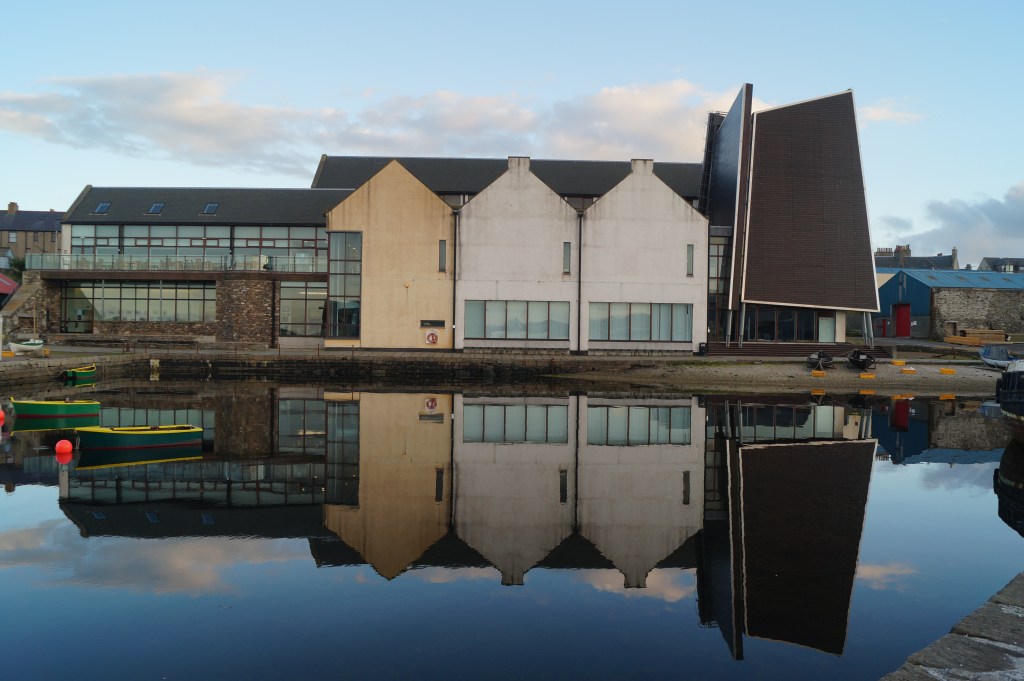
Shetland Museum & Archives
I not only knew of the Gunnister Man from crofters in that area, but also when I was a child as my late uncle had told me his story. While at school in Hamnavoe, Burra Isle, his class went on a school visit to Lerwick and to our local police station in particular. They were shown to a cell where they viewed the actual remains of the Gunnister Man. There was no body to be seen but they saw his clothes, which were in surprisingly good condition. The officer talking to them explained that in fact the remains although from the 1700s were still part of a crime scene. This story fascinated me at the time all those years ago, and here I was helping recreate some of the Gunnister Man’s clothing, it was as if I was involved in our living heritage.
Gunnister Man Information at Site
The official story is it was a lone burial at Gunnister, Northmavine which was discovered by two crofters casting peat. They unearthed the remains while cutting the peat from the turf in 1951. The remains date back to around the very end of the 17th century, early 18th century.
The bulk of what survived in the burial is the woollen clothing which is very heavily patched; so there are quite a number of different fabrics present. The non- clothing items were a wooden stick, small wooden bucket two other small pieces of wood, a wooden knife handle, a horn spoon, a quill and some Swedish and Dutch coins. Non fabric items included pieces of a leather belt with brass buckle and fragments of a rivlin type shoe.
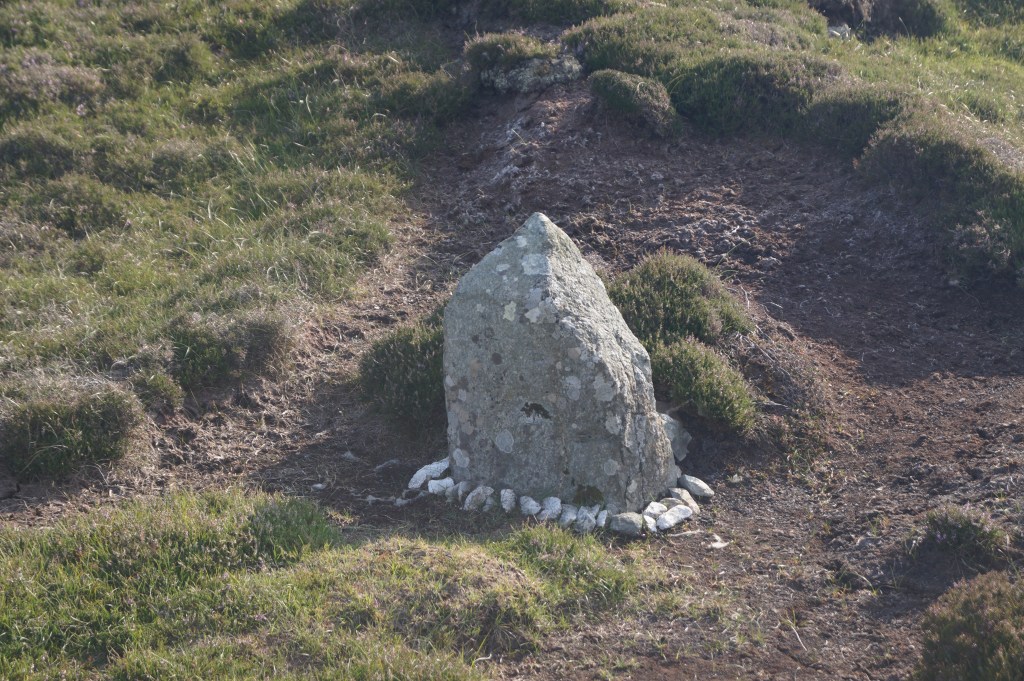
Gunnister Man’s Grave
Various theories were put forward to as how he would have met his end but no evidence was found to shed any light on his demise. Back in the 1700s, the burial site would have been in quite a remote area with no obvious roads and a peaty heather moorland.
At that period in time Gunnister Voe with its sheltered inlet, was one of a number of very small ports operating at the end of the Hanseatic League period traders from Holland and Germany visited our shores. The burial site is situated 2 miles from the port and at the top of a small valley bordered on the south side by hills and the north side Gunnister Loch. It is my theory that the unfortunate soul was a visitor with little knowledge of the area and was travelling on his own from the port in bad weather, possibly in the winter, and was caught in a blizzard with poor visibility and stumbled into the frozen loch. He then may have made it out as the loch is not too deep, and sought refuge under a peaty heathery overhang and succumbed to frostbite and hyperthermia. Over the years the peat and heather will have covered over his remains.
Gunnister Valley Leading to the LochA Peat Bank at Gunnister Today
Our task was to help identify the wool used to construct his apparel, our only help being photographs of the original clothing and scientific test results which proved the items had been obtained over a considerable time and from different locations. I looked mainly at the coarser Shetland wools similar to the Scandinavian types of Norway and Sweden. The sheep brought over by the Vikings when they settled here had a distinctive coarser staple.
Sorted Fleece Used in Restoring
On seeing the original clothes brought up for the reconstruction presentation I saw kemp fibres hair which does not take to the dye. Older, more experienced sheep men told me I would not find kemp in Shetland, only in the larger mainland breeds. There were various items of clothing and it is more than likely Shetland wool would have been present in, for instance, garments worn next to the skin.
Carol Sorting Fleece, January 2008
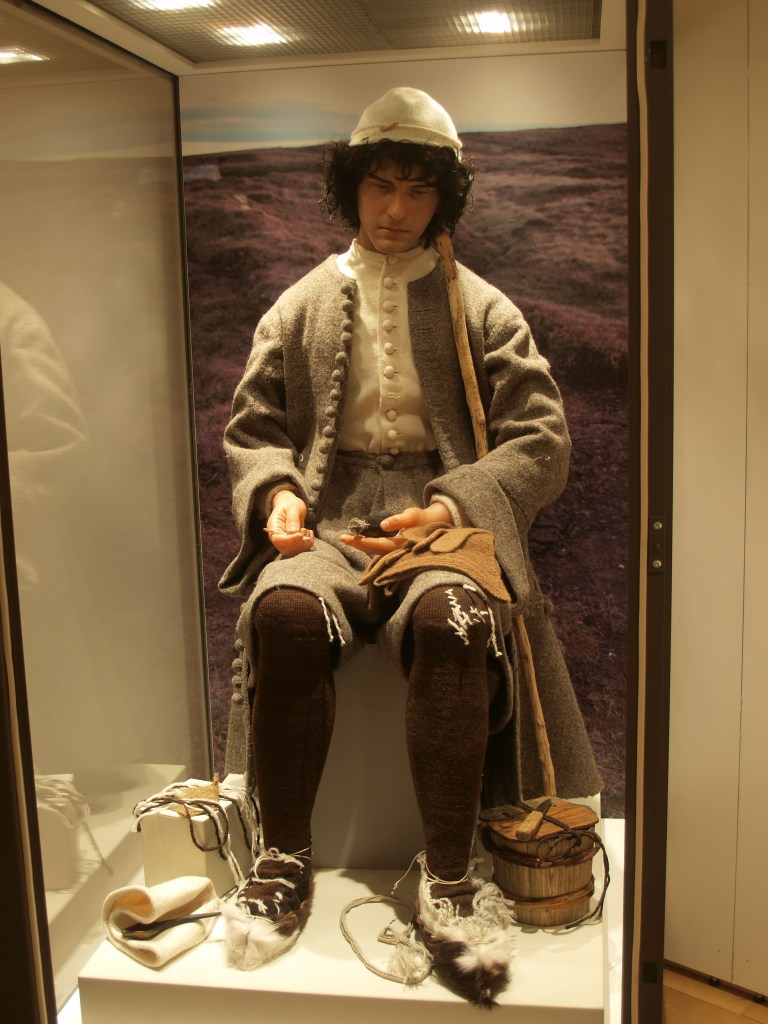
After three years the unveiling of the reconstructed Gunnister Man took place in the Lerwick museum before a large crowd, many of them were crofters. When I first viewed the “reborn” Gunnister Man I had the impression that I actually knew him. I had a measure of pride that I had been part of this unique natural history project. It rekindled in me an acute awareness of one of Shetland’s true strengths its vibrant textile heritage which had been an integral part of my early life. Perhaps as a business J&S did not gain commercially from this project; we gifted our time and the fleece to our local museum. What proved to be of greater significance, this project proved to be the stepping stone into a journey of exciting times working with Shetland Amenity Trust who were involved in the day to day running of the Shetland Museum and Archives.
Reborn Gunnister Man
The Gunnister Man was the beginning of a partnership with us at J&S and the Shetland Amenity Trust in developing new yarns and projects which would benefit knitters and textile workers and add value to the local Shetland wool clip.
Thanks to Carol Christensen and the Shetland Museum for the information and images, and also letting us take part in this historic event.
Part of our strategy for developing the company involved not only new products but also increased marketing and social media work. Attending knitting and stitches shows on the mainland also had a role to play, our first show under new ownership in 2006 was a trip to Woolfest at Cockermouth in Cumbria.
Lake View on the Way to Cockermouth
Woolfest is a celebration of natural fibres and all things wool related. J&S was invited to attend the festival by the organiser’s members of the Wool Clip, a Cumbrian cooperative, in 2005. Their aim is to celebrate all aspects of wool; from hill farming and rare breed fleece animals to the latest craft techniques and creations, an ideal event for our Real Shetland wool and products.
Catherine and I travelled down to the inaugural event on our own, which in itself was a bit of an adventure. We hired a fairly large vehicle which we crammed full of yarn, fleece and product. Our first impressions on arriving in Cumbria were an appreciation of stunning scenery, mountains and lakes.
Catherine Admiring the View
In the 2006 event we were ably supported by the parent company. They delivered our stand goods to us from their base in Bradford and helped us set up. This was a huge plus for us as now we did not have the strain of coping on our own; we appreciated the help from Curtis Wool Direct. I also had an opportunity to meet with one of the parent company’s key woolman who I would be working with from now on; a valuable connection. We took a selection of our yarns, design kits and other products, as well as fleece and combed tops. Woolfest was an ideal “shop window” in which to show of the very best of Shetland wool and yarns.
Andy from the Parent Company Helping Out
The event took place in the Cockermouth auction mart, space was not a problem and the open plan building made it quite airy, which was a godsend in what was a fairly hot month of June. We met lots of likeminded people from around the globe, made new friends and met up with a lot of old acquaintances.
Busy Stand at Woolfest 2006Oliver at Woolfest 2006
I met up with members of the mainland Shetland Sheep Breeders Society and of course their sheep. It was relieving to see that the high standards of breeding set up by the Shetland Flock Book Society were in good hands on the mainland.
Oliver Meets a Friend
We found the trip quite rewarding although it was a fair distance away and came at the start of our wool season, however it was worth the visit to what is one of the most beautiful parts of the UK.
In 2005, Jamieson & Smith owners Jim Smith, now 80 years old, and Eva Smith 74 years old, announced that they were retiring. They still had the two farms, as well as Papa, and one could safely say they had their hands full. They said they were considering selling to Curtis Wool Direct who now bought the wool we purchased, which was over 80% of the island clip.
I enquired if they would consider selling the company to me. The reply was, “No, the responsibility would be too great a burden on you.” I replied, “Can I at least approach the local agencies, the council, and Highlands & Islands Enterprise and our bank to see if I could gain financial support?” The answer from both agencies was no. At the time, I felt disappointed at the reaction but was not surprised as I was to find out later on, from a high ranking council official that they were in fact investors in another similar island business!
If the shock of Berry retiring from the business, their security and protection gone wasn’t enough to deal with I now had to adjust to a completely alien way of life to what I had been used to for 38 years; that was working for a large international wool group.
It was put to me quite bluntly, that I had to take on the role of manager as well as being a director; after discussing this with Catherine I went back with my decision to Jim & Eva that I had no education or experience of managing. Jim answered saying “You are very capable of doing the job,” and that they would “…always be there for advice.” “If you do not take on this role the sale will not happen and we simply have to close the company down and the jobs will be lost”.
So no pressure on me then! I, against my better judgement, took on the role and met with one of my new employers who was in Shetland to conclude the deal. He promised he would pay regular visits to us and there would be support and advice from them. “The first problem you have to deal with is that the other wool man has handed in his notice, so you will have to find a replacement.” Unfortunately, as it turned out, the opposite happened. He left Curtis Wool early 2006 at the same time our office manageress also left. Again, as if that was not enough to be going on, the SIC gave a similar local textile company a marketing grant of £100,000!
People would no doubt have sympathised with me if I had thrown in the towel at this stage, however one thing I am not is a quitter and, with the help of my close family and the recruitment of Derek Goudie and two new ladies in the yarn side of the business, we steadied the ship.
In early summer 2006 we had a visit from the Curtis Wool Direct joint managing director. His message was very simple; we have to turn this company around and make it a success – our aim being to increase the price of the raw wool we pay to the local producer. To do that we need to turn the wool into product and, most importantly, sell it.
The shop had a complete new makeover since the early days of the 1970s, this display of all the shades made the customer very aware of what we had to offer.
Real Shetland Yarns & ProductsJ&S Shop
Curtis Wool put into place a registered brand the “The Three Sheep Logo”, as Shetland wool has no defined brand to protect producers and customers from the mass produced imitation Shetland textile products which flood the market made from foreign wools. Our registered logo features three Shetland sheep and guarantees the end user that when applied to the textile products it is made from the finest Real Shetland wool from crofters and farmers in Shetland. Users of our yarns will be able to display our brand on all their finished products, and this will guarantee authenticity.
Three Sheep Logo
The takeover in 2005 meant we now had a positive way forward and very capable mentors & supporters at the parent company. Together with the parent company Curtis Wool Direct we have developed new products and sought out new markets. We share the same belief that together we can achieve our combined goal in turning the company around, adding value to the local wool clip purchased by us, in turn paying the wool producers more for their wool.
The global drop in wool prices in the early-to-mid 1950s, the introduction of man-made fibres meant Shetland wool producers were hit extremely hard, as were producer’s worldwide. Prior to this Shetland wool commanded a very high price due to the demand for its specialist high end wool qualities. I recall an elderly farmer in the 1970s telling me in no uncertain terms how displeased he was with the wool cheque I had just given him on the sale of his wool. He said he could remember when he could employ two full time farm workers for a year, “…and now look at the price you are paying, it is hardly worth shearing.” Another farmer said not so long ago, “I could buy a tractor with my wool clip, what you have paid me today can hardly pay for the fuel in filling up my tractor.” I had no reply on either occasion.
Where wool had been the cash crop once upon a time, a solution had to be found. The price for the small Shetland lamb was unable to bridge the gap, although it was much better than the producer receives today. In order to help matters crofters and farmers came up with a Shetland cross bred sheep. This was the Shetland Cheviot, an island breed which meets modern needs.
Cheviot Sheep
A Shetland Cheviot is bred in Shetland from a Shetland ewe and a North Country Cheviot ram. The Shetland Cheviot inherits the prolificacy, hardiness, easy lambing, milkiness and mothering ability of the Shetland breed, with the superior carcass conformation and growth of the North Country Cheviot.
A Flock of Crossbred Sheep
The Shetland Islands are renowned for their natural and healthy environment. Bred in this environment, in which there is no evidence of sheep disease being detected, the Shetland Cheviot has a high health status maintained by the participation of many flocks in the Highlands and Islands Sheep Health scheme.
Crossbred with Suffolk TwinsCrossbred Ewe with Suffolk Lamb
The Shetland Cheviot is adaptable to a wide range of management systems and stocking densities. The small mature size of the Shetland Cheviot makes good physical and economic sense with high stocking rates achievable. Individual ewe performance is also good and record flocks, when crossed with the Suffolk, ram are producing top performance.
A Lamb from a Suffolk Sire to a Crossbred Ewe
Of course these animals are not as hardy as the Shetland breed and require land which has been improved in order to produce a richer greener pasture and provide adequate grazing for the cross bred sheep which would not thrive on native pastures of peat moor and heather clad hills. They require more attention in animal husbandry such as winter fodder and at lambing time. The wool is of good quality but cannot compare with the superb characteristics of the Shetland breed with ultra- fine fibre and distinct handle.
It would be fair to say Eva could have been overawed at having such a gifted sibling in Jim a Berry with all his inventions and creations; he was more of an outgoing person while Eva remained in the background. Eva from an early age accompanied her father on his trips to the mainland attending shows and livestock auction sales. Their base on the mainland was their farm/estate of Pitmedden on the outskirts of Aberdeen which John Smith purchased in the early 1930s.
Pitmedden HouseEva on a Shetland Pony at an Early Age
It was no surprise that it was Eva who took the lead at Berry Farm when their dad’s health failed and he eventually passed away. Berry always had very capable farm workers they had a good grasp of general farm work and Eva worked alongside them learning from the likes of Magnie Smith of Berry.
Eva and Magnie Preparing to Sow Corn
Eva at an early age built up a reputation as being amongst the best in her breeding and knowledge of Shetland ponies, taking many honours at home and the UK mainland. In 1948 she was appointed as judge in the Shetland pony class at the Royal Highland Show, thus becoming the youngest judge selected at that time. She was also a pony judge in Ireland and was invited to judge in Australia, but felt it was too long to be away from Berry.
When Eva was not working on the farm or with her ponies one of her favourite pastimes was horse riding, and would be seen galloping through the Berry fields on her horses.
Eva on Mohawk, Her Horse
When I was working at Berry farm in the late 1960s I soon found out who wore the trousers. Eva was always giving out orders making it very clear who was boss. When we were taking in the harvest, be it hay or corn, Eva would work on one side of the tractor and trailer and I the other, loading the harvest on board the trailer.
Eva Stooking Corn at East Park, Berry
When “caaing” (gathering) the sheep, Eva had to be at the forefront. My last Berry hill round up she insisted, although quite elderly, to take her place with her faithful dog in time served tradition.
Eva Caaing Berry Hill
As I mentioned before she was a fierce competitor and could be quite critical of pony judges especially visiting ones from further afield. I remember a classic example in the year 2000; Eva entered a stallion in a very prestigious local show and came last in the class. She came in to the work furious, vowing never to compete again and what did that judge know about horses. I had asked, “So you will not be taking part in the Shetland Millennium Show?” “No,” was the angry response. I replied, “We shall see, I will be at the show and I will take your picture receiving the Supreme championship from H.R.H Prince Charles!” This was met with a, “No you won’t!” The image below clearly shows I was correct!
Eva Receiving Her Trophy from H.R.H Prince Charles
Eva took part in many pony shows and was very fortunate to have someone like Jim who could turn his hand to anything when required. Two images below of a sulky and horse gig were built by Jim.
Eva on a Sulky Built by JimEva, Jim and Bjorn on a Gig Built By Jim
Eva had a great interest in Jamieson & Smith created by her dad, and when he passed away took on the joint running of the company with Jim. This connection with the company carried on even after they sold the company in 2005. Shortly before she died in March 2018, Eva was still giving me orders on how the company should be run. That last conversation summed up the type of people the Smith family were, Eva thanked me for all the hard work I had done for their family over the years at the wool store and at Berry Farm. Very dignified, respectful of others and very humble, it was a great honour for me to work for them and also to be one of the Berry boys, they are sadly missed.
I now move forward in my journey with Shetland wool in upcoming blogs.
My first sighting of Berry Farm was while approaching Scalloway harbour on the ferry from Burra in the 1950s, our destination Blackness Pier. A group of Shetland ponies were grazing on the hill above Port Arthur. My only encounter with a pony before this had been at Quarff when we visited my auntie’s croft. The pony was used to take the peats in from the hill. I was placed on the pony and I promptly fell off. It would be fair to say that this was a bad introduction to this renowned breed.
A Very Young Oliver on a Shetland PonyBerry Farm Ponies at Port Arthur, Scalloway
This was all to change when I began to work for the Smith family, I soon found out their ponies were much revered and were like an extended family, such was the care and attention paid to them. They were not as popular with the farm workers as they were notorious for leaning on and breaking fence posts and they most definitely had a mind of their own.
Tamazin and Tamward of Berry, 2013
Shetland ponies had been a great passion of my old boss John “Sheepie” Smith and the family grew up around the ponies. Of course they were initially practical working ponies carrying out all the farm duties such as ploughing and carrying heavy loads such as taking home the peats.
John “Sheepie” Smith and a Shetland Pony at Berry FarmMagnie o’ Berry Ploughing at Berry
With the introduction of farm machinery ponies were spared the arduous farm work and became mainly show ponies and pets. I was soon to find out that although the ponies were the property of the Berry Stud, there was a competitive rivalry between Eva and Jim as to who was the best pony breeder. Jim concentrated on the miniature pony while Eva was more on the standard breed. The Berry stud was famous worldwide and their bloodline was much sought after.
Jim Training Gingi of BerryJim and Eva Selecting Ponies
In the early 1970s I recall having to help out loading ponies at Berry farm, their destination was Norway; this was a very strong marketplace, not only for Berry but Shetland pony breeders in general. The ponies were delivered down to Sumburgh airport by Jim in the Berry van and loaded on to a fairly large cargo plane. I was to travel over with the ponies to help out but was disappointed to learn that Jim would be the only passenger allowed to travel.
Shipping Berry Ponies to Norway, 1972
Jim and Eva’s interest remained resolute right up to their final years; you could look out upon what was their pride and joy the Berry ponies. I am pleased to say on a recent visit to Berry the ponies are still in place, where they should be. I attended the Walls agricultural show recently and had a look at the Shetland ponies on show. I recognised one of the breeders who I had seen in the past at Berry farm, I asked was there any of the Berry stud left, he proudly pointed out a beautiful pony its name Beechnut of Berry it did quite well at the Walls show, however at the larger county best of breeds show Beechnut of Berry came out top in the best of breed miniature class. I know that the Berry people would be delighted that their ponies are still acknowledged as amongst the best a very fitting legacy.







 My Life with Shetland Wool